
UNIMOD-12 FSK Modem
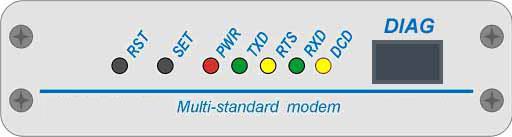
UNIMOD-12 FSK Modem
UNIMOD-12 is a multi-channel industrial FSK modem. 12 independent channels with FDM multiplexing in 300–3400 Hz voice band. Data transmission 50–1200 Bd. 2/4-wire analog line, RS-232C. Designed for SCADA and RTU communications on energy transmission lines.
UNIMOD-12 Industrial FSK/QAM Modem
UNIMOD-12 is a multi-channel industrial modem platform housing 12 independent FSK modem channels in the 300–3400 Hz voice band, designed for energy and industrial communications networks. Using FDM (Frequency Division Multiplexing) technology, it simultaneously multiplexes multiple low-speed data connections over a single analog line.
Each channel is independently configurable: different center frequency, baud rate, and operating mode can be assigned. This architecture provides an efficient solution, especially in scenarios where multiple RTU and SCADA points along energy transmission lines must communicate over a single leased line or PLC channel.
| Feature | Details |
|---|---|
| Number of Channels | 12 independent FSK modem channels |
| Modulation | FSK (Frequency Shift Keying) |
| Frequency Band | 300 – 3400 Hz voice band |
| Channel Multiplexing | FDM (Frequency Division Multiplexing) — each channel at different center frequency |
| Speed Range | 50 – 1200 Bd (per channel) |
| Line Interface | 2/4-wire analog line, 600Ω impedance |
| Data Interface | RS-232C (independent per channel) |
| Operating Modes | Half-duplex, full-duplex, point-to-point, point-to-multipoint |
| Power Supply | 24/48 VDC or AC options |
| Mounting | 19" rack mounting |
FDM-Based Multi-Channel Architecture
UNIMOD-12 uses FDM (Frequency Division Multiplexing) technology to divide the 300–3400 Hz voice band into narrow sub-bands. Each sub-band operates as an FSK modem channel. This approach enables up to 12 independent data streams to be simultaneously carried over a single physical line.
The FDM architecture increases channel density without requiring additional hardware or line capacity, making it the preferred choice in energy transmission lines and remote field connections where leased line costs are high.
Application Areas
- Multi-point SCADA communications on power transmission and distribution lines
- RTU data collection between transformer stations
- Multiple low-speed data channels over leased lines
- PLC (Power Line Communication) based multi-channel transmission
- In-plant telemetry and remote monitoring
| Modem Featureleri | |
|---|---|
| Frequency Range | 300–3400 Hz audio band |
| Modulation | FSK (low speeds), QAM 4/8/16 (high speeds) |
| Supported Standards | CCITT V.29, R.38A, R.38B, R.37, R.35, V.23, BELL 103, BELL 202, Cegelec |
| Processor | Texas Instruments 32-bit DSP |
| Operating Mode | Full-duplex, half-duplex, point-to-point, point-to-multipoint |
| Configuration | Hayes AT commands (DIAG serial port) |
| Interfaces | |
| Data Interface | RS-232 (SUB D 9-pin), ITU-T V.24/V.28 |
| Diagnostik | RJ-45 8-pin (DIAG port) |
| Analog Hat | SUB D 15-pin (2 or 4 analog line pairs) |
| Empedans | 600Ω / 10kΩ (configurable via jumper) |
| Transmit Level | 0–32 dBm (0.1 dB steps) |
| Minimum Receive Level | -48 dBm |
| FSK Channel Configuration | |
| Speed Range | 50 bps – 2400 bps (FSK), 4800–9600 bps (V.29) |
| V.23 Channels | 600 Bd / 1200 Bd kanallar |
| Special Channels | Cegelec 600/1200 Bd, CCITT R.35/R.37/R.38 |
| Frequency Inversion | AT&RFx command (including TEIAS applications) |
| Hardware | |
| Mounting | 1U/2U rack (1-3 modem) or 3U rack (10-14 modem), desktop |
| Indicators | PWR, TXD, RTS, RXD, DCD LED'leri |
| Power (12V model) | 9–18 VDC, 260mA |
| Power (24V model) | 18–36 VDC, 127mA |
| Power (48V model) | 36–60 VDC, 60mA |
| Max. Consumption | 3 VA |
| Security | IEC 62368-1:2014, EN 62368-1:2014+A11:2017 |
| Operating Temperature | <40°C |
| Positioning | |
| Application Areas | SCADA/RTU communication, data transmission over energy transmission lines, teleprotection signaling, industrial control |
For detailed technical information, please refer to the product datasheet or hardware user manual.