What Is IP/MPLS? Critical Infrastructures and Service Provider Networks
What Is IP/MPLS?
IP/MPLS is a technology in which packets are transported through a network not merely based on destination IP addresses, but through label-based transmission logic. At the network entry point, packets are classified, assigned an appropriate label, and then transmitted more quickly and consistently across the network backbone using this label.
This approach makes network behavior significantly more deterministic and predictable, especially in large and complex backbone networks.
The core capabilities provided by IP/MPLS are as follows:
-
Ability to direct traffic along specific paths (Traffic Engineering)
-
Service prioritization and quality management (QoS)
-
Extremely rapid recovery in redundancy scenarios (Fast Reroute)
-
More organized and manageable structure in large topologies
How Does IP/MPLS Work? (Label Logic and LSP)
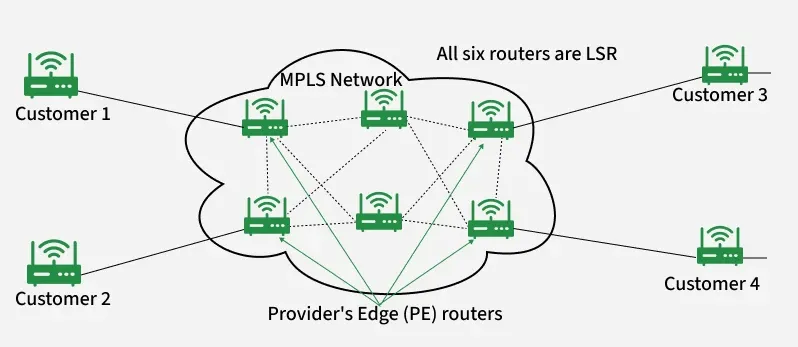
In MPLS networks, transmission typically occurs across paths called LSP (Label Switched Path). The basic operational logic works as follows:
-
At the network entry (ingress), packets are classified and labeled
-
Along the backbone, routers forward packets based on the label without examining the IP header
-
At the network exit (egress), the label is removed and the packet is delivered to the destination network
Through this architecture, backbone behavior becomes consistent. Policies such as "This service should travel along this path" or "This traffic should be carried with priority" can be applied in a stable manner across the entire network.
The Difference Between IP/MPLS and Classical IP Routing
In classical IP routing approaches, each router determines the next hop by examining the packet's destination IP address. For small and simple networks, this method may be sufficient; however, certain problems emerge in large backbone networks:
-
Route behavior can become unpredictable during traffic fluctuations
-
QoS policies may be applied inconsistently end-to-end
-
Service differentiation (customer or architectural isolation) becomes more difficult
-
Operational management overhead increases in large networks
IP/MPLS, on the other hand, provides a more programmable architecture in the backbone. This difference directly reflects on operational stability, especially in service provider and critical infrastructure networks.
QoS and Traffic Management: Protecting Critical Services
In critical infrastructures, not all traffic carries equal importance. For example, carrying SCADA control traffic and CCTV image traffic at the same priority level can create serious risks to system stability.
IP/MPLS architecture enables cleaner and more controlled application of QoS policies:
-
Traffic classes can be created (critical / important / best-effort)
-
Delay-sensitive services can be prioritized
-
Bandwidth management can be performed (shaping / policing)
-
End-to-end service behavior becomes more consistent
In this way, multiple services can be transported over a single backbone while critical traffic remains protected even during periods of heavy congestion.
High Availability: Fast Reroute and Resilience
In energy, railway, and telecom backbones, one of the most critical expectations is rapid recovery during failures. In the IP/MPLS world, to meet this requirement, Fast Reroute (FRR) mechanisms are commonly used.
The goal is straightforward:
During a link or node failure, traffic is switched to an alternative path in the shortest possible time (on the order of milliseconds). This minimizes service interruption and allows critical applications to continue operating without entering a break-and-recovery cycle.
Why Is IP/MPLS Preferred in Energy and Railway Projects?
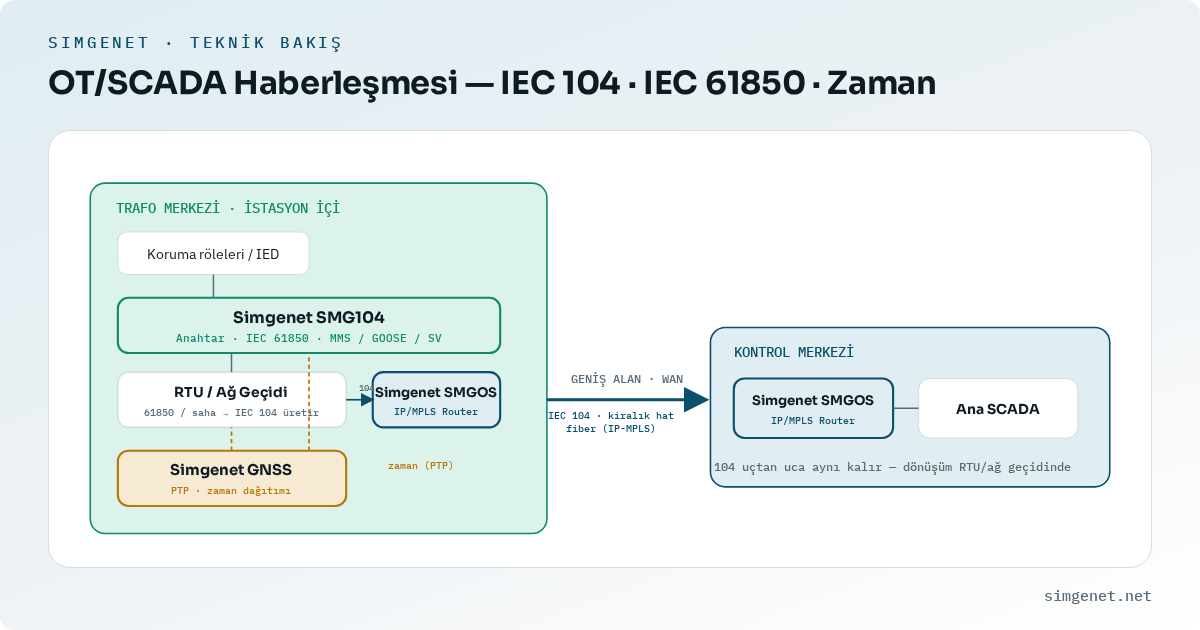
In environments such as energy transmission centers (154 kV / 400 kV), transformer stations, and railway lines:
-
Communication interruption is unacceptable
-
SCADA, teleprotection, CCTV, and signaling are carried over the same backbone
-
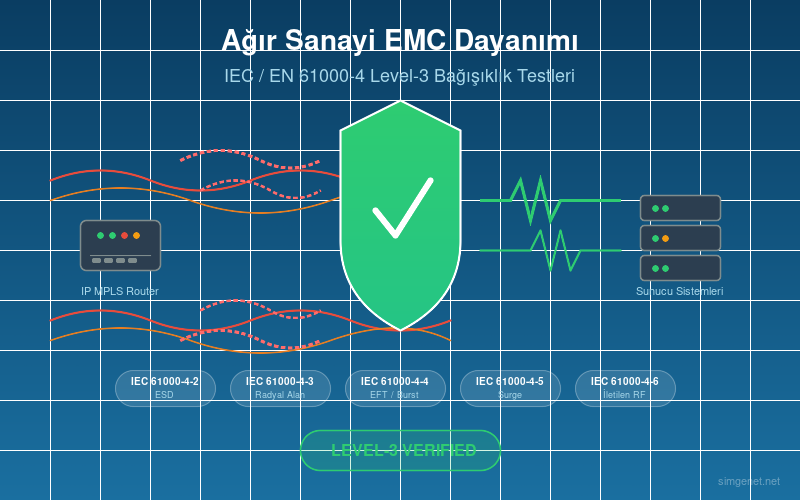
EMC/EMI and industrial conditions (temperature, vibration, field environment) play a critical role
-
Redundancy is expected in ring and mesh topologies
IP/MPLS architecture stands out in these environments with the following advantages:
-
Ability to carry multiple services over a single backbone
-
High resilience in ring and mesh configurations
-
Service prioritization to protect critical traffic
-
Ability to work alongside existing infrastructure (where needed, TDM transport scenarios)
For these reasons, IP/MPLS is often the backbone of industrial and critical field communications.
IP/MPLS in Telecom and ISP Networks
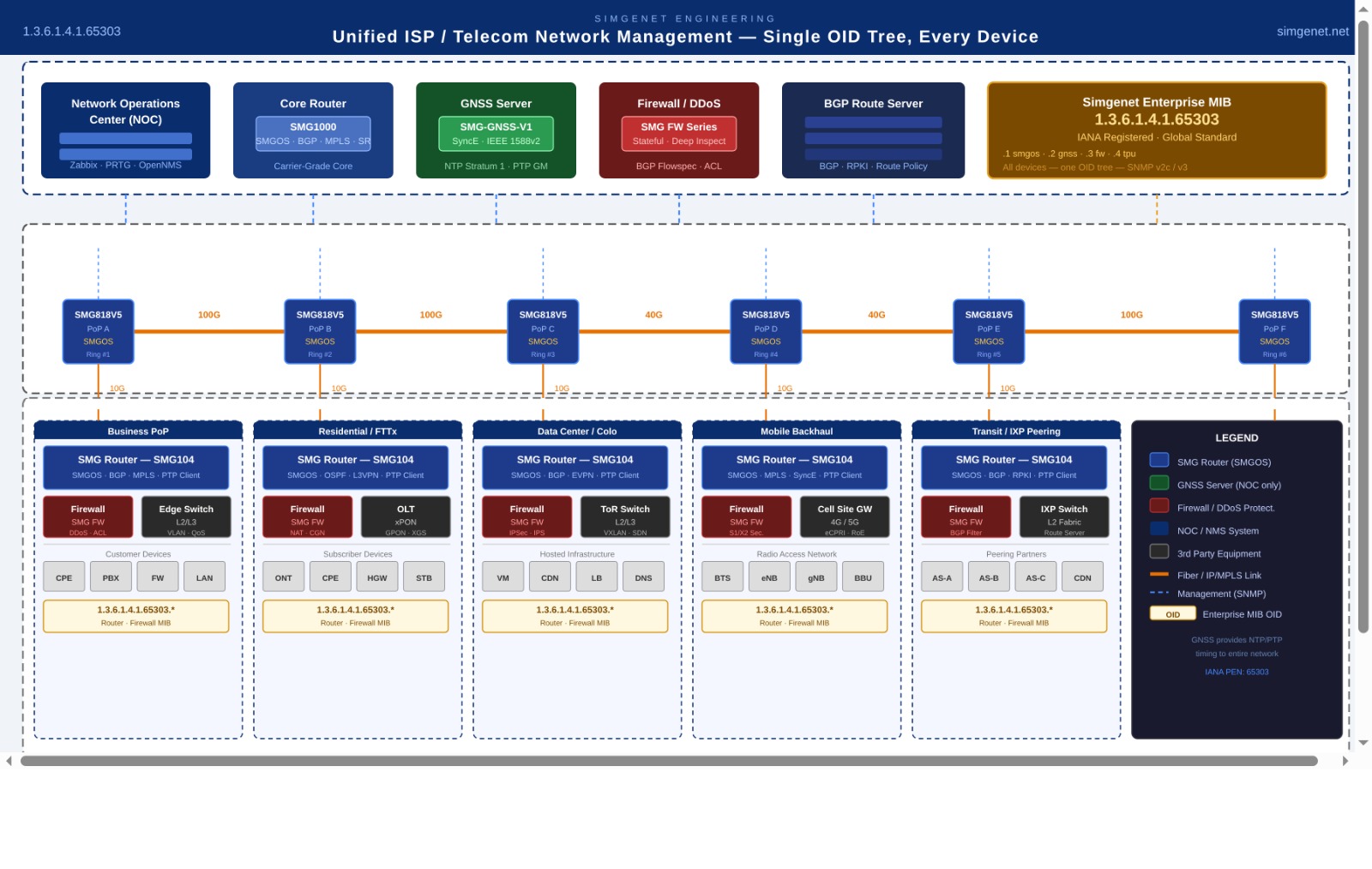
In telecom operators and ISPs, requirements differ in scale: high subscriber traffic, different service types, virtual networks for enterprise customers, and ever-growing capacity demands on the backbone.
Common reasons for IP/MPLS adoption in such networks are:
-
Efficient capacity utilization through traffic engineering on the backbone
-
Customer isolation through L2VPN and L3VPN services
-
Scalable service delivery in metro and core networks
-
Ability to manage voice, video, and enterprise data on the same infrastructure through QoS
In summary, IP/MPLS is one of the fundamental building blocks of large-scale network operations for telecom and ISP providers.
Conclusion: IP/MPLS Is Not a Technology, But an Infrastructure Approach
IP/MPLS is not merely a routing protocol; it is a holistic transport architecture designed for critical infrastructures and service provider networks. When implemented with the right hardware and proper architecture, it creates a robust and scalable communications backbone capable of serving reliably for many years.