
SMG818V5 Industrial IP/MPLS Router
SMG818V5 Industrial IP/MPLS Router
Simgenet SMG818V5 is a modular Industrial IP/MPLS platform running on the in-house developed SMGOS software. Designed for energy, railway, telecom and ISP infrastructures with 1G/10G/40G/100G interface support, advanced routing and MPLS services, Segment Routing and IEEE 1588v2 PTP time synchronization.
Modular IP/MPLS Platform for Critical Infrastructures
SMG818V5 is a modular IP/MPLS platform designed for long-term, uninterrupted operation in energy transmission systems, railway communication infrastructures, telecom and ISP backbones. Running on the in-house developed SMGOS software infrastructure by Simgenet, this platform provides an engineering-driven solution for critical backbone scenarios with advanced routing and MPLS capabilities, IEEE 1588v2 PTP time synchronization support and scalable hardware architecture from 1G to 100G.
SMG818V5, where software and hardware are developed together, targets high continuity, fast convergence and predictable performance at edge, aggregation and service access layers.
In-House Developed SMGOS IP/MPLS Software Infrastructure
SMGOS, running on SMG818V5, is an IP/MPLS routing operating system fully developed in-house by Simgenet.
- No dependency on third-party routing software
- Provides full control, customizability and long-term sustainability
- Features an architecture optimized for critical infrastructure and service provider networks
SMGOS is designed to respond to changes in network topology at millisecond level.
Protocol and Service Support
SMG818V5 offers a wide range of protocols and services through the SMGOS infrastructure:
- Routing: OSPFv2, IS-IS, BGP (iBGP/eBGP/RR), BGP Add-Path, RIPv2
- MPLS: LDP, MPLS L3 VPN (RFC 4364), MPLS L2 VPN / EoMPLS, Segment Routing (SR-MPLS)
- Layer 2: VLAN, Q-in-Q, LACP, STP/RSTP/MSTP, LLDP, VXLAN
- Services: QoS / Traffic Shaping, DHCP Server/Relay, NAT (SNAT/DNAT/PAT/VRF-aware), PPPoE
- VPN: IPsec VPN (Site-to-Site), VRF
- Time: IEEE 1588v2 PTP — T-GM / Boundary Clock (G.8275.1/.2, 61850, PRTC-A), NTP/SNTP (GNSS Stratum-1)
- Management: SNMP v2/v3, RADIUS (AAA), Syslog, SSH, NETCONF
- High Availability: BFD, Fast Convergence, ECMP
Modular Hardware Architecture
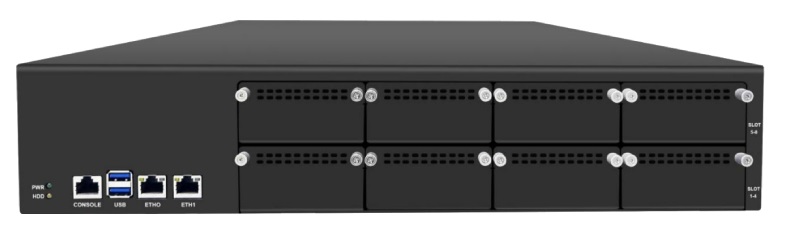
SMG818V5 features 8 PCIe Gen5 x8 slots in a 2U rackmount form factor. This modular architecture offers:
- 1G / 10G / 25G / 40G / 100G / 200G Ethernet card combinations
- Configurable slot architecture with fiber Ethernet cards
- Application-specific port and card configurations
This architecture provides a flexible design for critical infrastructures where capacity requirements can change over time.
Control Plane and System Resources
- Multi-core Intel® Xeon® processor support (Xeon 5418Y)
- Up to 256 GB DDR5 ECC memory (16x DDR5 4400/4800 ECC)
- Control plane optimized for intensive routing and MPLS scenarios
This architecture targets stable operation under high BGP table sizes, multiple VRF scenarios and heavy protocol loads.
Industrial Durability and Field Suitability
- EMC Level 3 industrial durability (TS/EN 61000-4 Level 3)
- Operating temperature: -20°C ~ +60°C
- Design suitable for energy, railway and industrial facility environments
- Structure optimized for 24/7 long-term field operation
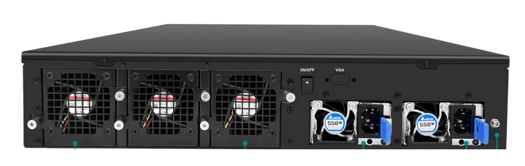
- 2x 220 VAC, 250W redundant power supply
Application Areas
- Railway communication infrastructures (GSM-R / FRMCS / ETCS based IP/MPLS transport)
- Energy transmission and transformer substations (154/400 kV)
- ISP and Metro Ethernet backbones
- Edge and aggregation layers in telecom service provider networks
- Critical infrastructure and industrial automation networks
Technical Comparison Table
| Feature | SMG411 Edge Router |
SMG104 Aggregation |
SMG818V5 Industrial |
SMG1000 Industrial |
|---|---|---|---|---|
| HARDWARE PLATFORM | ||||
| Operating System | SMGOS | SMGOS | SMGOS | SMGOS |
| Chipset / Platform | Intel | Intel C236 | Intel® C741 | ICX 4309Y |
| CPU | Intel | Intel Xeon E3-1200 v5 | Xeon 5418Y | Xeon ICX 4309Y |
| Memory (RAM) | 16 GB | Max. 64 GB DDR4 | 16x DDR5 ECC | 16x DDR5 ECC |
| Form Factor | 1U Rackmount | 1U Rackmount | 2U Rackmount | 4U Rackmount |
| Dimensions | N/A | 430×550×44 mm | 440×592×88 mm | N/A |
| Power Supply | 220 VAC, 250W | 220 VAC, 250W | 2x 220 VAC, 250W | 2x 220 VAC, 250W |
| Operating Temperature | -20°C ~ +60°C | -20°C ~ +60°C | -20°C ~ +60°C | -20°C ~ +60°C |
| EMC Certification | CE, RoHS, TS/EN 61000-4 Level 3 | CE, RoHS, TS/EN 61000-4 Level 3 | TS/EN 61000-4 Level 3 | TS/EN 61000-4 Level 3 |
| EXPANSION & PORTS | ||||
| PCIe Slot | PCIe based | 4x PCIe Gen3 x8 | 8x PCIe Gen5 x8 | Model A: 1x / Model B: 2x PCIe Gen4 |
| Max. Uplink Speed | 10G | 100G | 100G | 200G |
| Max. Ethernet Ports | Fixed configuration | 32x 1G / 8x 10G / 4x 25G | 64x 1G / 16x 10G / 8x 25G / 4x 100G | 80x 1G / 24x 10G / 8x 100G |
| Console / Management | RS-232, USB, RJ45 Mgmt | RS-232, USB, RJ45 Mgmt | RS-232, USB, RJ45 Mgmt | RS-232, USB, RJ45 Mgmt |
| ROUTING & MPLS | ||||
| Statik Route / PBR | ✓ | ✓ | ✓ | ✓ |
| RIPv2 | ✓ | ✓ | ✓ | ✓ |
| OSPFv2 / OSPFv3 | ✓ | ✓ | ✓ | ✓ |
| IS-IS | ✓ | ✓ | ✓ | ✓ |
| BGP (iBGP / eBGP / RR) | ✓ | ✓ | ✓ | ✓ |
| BGP Add-Path | ✓ | ✓ | ✓ | ✓ |
| MPLS / LDP | ✓ | ✓ | ✓ | ✓ |
| MPLS L3 VPN (RFC 4364) | ✓ | ✓ | ✓ | ✓ |
| MPLS L2 VPN / EoMPLS | ✓ | ✓ | ✓ | ✓ |
| Segment Routing (SR-MPLS) | ✓ | ✓ | ✓ | ✓ |
| VRF | ✓ | ✓ | ✓ | ✓ |
| VXLAN | ✓ | ✓ | ✓ | ✓ |
| Fast Convergence / ECMP | ✓ | ✓ | ✓ | ✓ |
| BFD | ✓ | ✓ | ✓ | ✓ |
| SERVICES & SECURITY | ||||
| QoS / Traffic Shaping | ✓ | ✓ | ✓ | ✓ |
| DHCP Server / Relay | ✓ | ✓ | ✓ | ✓ |
| NAT (SNAT/DNAT/PAT/VRF-aware) | ✓ | ✓ | ✓ | ✓ |
| IPsec VPN (Site-to-Site) | ✓ | ✓ | ✓ | ✓ |
| OpenVPN | ✓ | ✓ | ✓ | ✓ |
| PPPoE | ✓ | ✓ | ✓ | ✓ |
| IEEE 1588 PTP v2 | ✓ | ✓ | ✓ | ✓ |
| NTP / SNTP | ✓ | ✓ | ✓ | ✓ |
| SNMP v2/v3 | ✓ | ✓ | ✓ | ✓ |
| RADIUS (AAA) | ✓ | ✓ | ✓ | ✓ |
| Syslog | ✓ | ✓ | ✓ | ✓ |
Which Model Should You Choose?
All models run the same SMGOS software and the same protocol set. Model selection should be based not on software capabilities, but on environmental durability requirements, port/uplink capacity and physical space.
Criterion 1: Environmental Conditions
| SMG411 / SMG104 | SMG818V5 / SMG1000 | |
|---|---|---|
| Environment | Controlled room, data center, air-conditioned cabinet | Transformer substation, field cabinet, open area, railway station |
| Temperature | -20°C ~ +60°C | -20°C ~ +60°C |
| EMC Level | TS/EN 61000-4 Level 3 | TS/EN 61000-4 Level 3 |
| Result | All models EMC Level 3 compliant | All models EMC Level 3 compliant |
Criterion 2: Port / Uplink Capacity
| SMG411 | SMG104 | SMG818V5 | SMG1000 | |
|---|---|---|---|---|
| PCIe Slot | Compact | 4x Gen3 | 8x (Gen5) | Model A: 5× Gen4 / Model B: 10× Gen4 |
| Max. Speed | 10G | 100G | 100G | 200G |
| Suitable Scenario | Few ports, low bandwidth | Medium-high ports, multiple uplink | High port density, multiple cards | High port density, multiple cards |
Criterion 3: Physical Space
| SMG411 | SMG104 | SMG818V5 | SMG1000 | |
|---|---|---|---|---|
| Form Factor | 1U Rackmount | 1U Rackmount | 2U Rackmount | 4U Rackmount |
| Note | Fits narrow cabinets | Standard rack | More card capacity | More card capacity |
Built-in SIP Server (VoIP)
Thanks to the Asterisk-based built-in SIP Server running on the SMGOS operating system, the router can also function as a basic IP telephone exchange. In locations without a telephone exchange, SIP numbers obtained from the ISP can be directly assigned to the router for VoIP communication.
- Unlimited SIP Extensions: Any number of internal lines can be defined as needed
- ISP SIP Trunk Integration: Directly integrates with SIP numbers obtained from the service provider
- Basic PBX Functions: Internal calls, call forwarding, dial plan support
- Management: Configuration via CLI; web interface and Simgenet NMS coming soon
| Hardware Platform | |
|---|---|
| Operating System | SMGOS (Simgenet in-house developed IP/MPLS NOS) |
| Form Factor | 2U Rackmount Industrial Chassis |
| Dimensions (G×D×Y) | 440 × 592 × 88 mm |
| Processor (CPU) | Intel® Xeon® Scalable (4. / 5. Nesil) |
| Memory (RAM) | DDR5 ECC |
| Expansion Architecture | PCIe Gen5 |
| Power Supply | Redundant power supply |
| Fan System | Hot-swappable intelligent fan modules (replaceable during operation) |
| Modular Ethernet Card Architecture | |
| Supported Speeds | 1G / 10G / 40G / 100G / 200G Ethernet modules |
| Interface Options | SFP / SFP+ / QSFP+ / QSFP28 |
| Example Modules | SMG3500PF-4SFP-M, SMG7100PF-4SFP+-M, SMG8100PF-2QSFP28-M |
| Routing Protocols | |
| Basic Routing | Static, Default, Policy-Based Routing (PBR), Route Redistribution |
| NAT | SNAT, DNAT, PAT, VRF-aware NAT |
| IGP | OSPFv2, IS-IS (L1/L2), IS-IS Wide Metrics |
| BGP | iBGP/eBGP, Multipath, ECMP, Communities, Extended Communities, Add-Path, Flowspec, Graceful Restart/Shutdown |
| IP Address Management | DHCP Server/Relay, VRF-aware, ARP |
| MPLS and Advanced MPLS | |
| MPLS Core | IP MPLS, MPLS LDP, Label Push/Pop/Swap, PHP, TTL Propagation |
| MPLS VPN | L2VPN (VPWS, VPLS), L3VPN, VRF-based MPLS services |
| IPsec VPN | IKEv2; encrypted WAN / VTI tunnel |
| Site-to-Site VPN | branch-to-branch encrypted connectivity via IPsec/VTI |
| Remote Access VPN | OpenVPN server |
| QoS | Classification, marking (DSCP/MPLS-EXP), policing/shaping, HQoS (hierarchical queuing), CoPP |
| Segment Routing | SR-MPLS, TI-LFA, OSPFv2/IS-IS SR Extensions |
| Protection / OAM | BFD (hardware-accelerated, bidirectional), S-BFD, Y.1731 / 802.1ag CFM (LBM/LBR, ETH-DM, ETH-LM), TWAMP-Light and STAMP reflector |
| Traffic Control | BGP Flowspec, control-plane protection (CoPP), ACL |
| Software Lifecycle | install add / activate / commit / rollback; confirmed commit with automatic rollback if not confirmed in time; configuration vault (save, diff, rollback) |
| Physical Layer Diagnostics | Speed/autoneg/FEC status, CRC and symbol error counters, optical power (DOM), cable type, G.826 ES/SES/BBE/UAS |
| Traffic Control | BGP Flowspec, control-plane protection (CoPP), ACL |
| Software Lifecycle | install add / activate / commit / rollback; confirmed commit with automatic rollback if not confirmed in time; configuration vault (save, diff, rollback) |
| Physical Layer Diagnostics | Speed/autoneg/FEC status, CRC and symbol error counters, optical power (DOM), cable type, G.826 ES/SES/BBE/UAS |
| Traffic Control | BGP Flowspec, control-plane protection (CoPP), ACL |
| Software Lifecycle | install add / activate / commit / rollback; confirmed commit with automatic rollback if not confirmed in time; configuration vault (save, diff, rollback) |
| Physical Layer Diagnostics | Speed/autoneg/FEC status, CRC and symbol error counters, optical power (DOM), cable type, G.826 ES/SES/BBE/UAS |
| Fast Convergence and Redundancy | |
| ECMP | Equal-Cost Multi-Path traffic distribution |
| BFD | Bidirectional Forwarding Detection |
| Timer Settings | Hello / Dead / Keepalive / Holdtime tuning |
| Time Synchronization | |
| PTP | IEEE 1588-2008 PTP v2 — T-GM (Grandmaster) / T-BC (Boundary Clock) / Ordinary Clock; reboot-free BC↔GM (BMCA) |
| PTP Profiles | ITU-T G.8275.1 (L2, E2E, domain 24–43) · G.8275.2 (L3/UDP-IPv4, E2E, 44–63) · IEC/IEEE 61850-9-3 power (P2P, 0–127) — profile auto-locks layer & delay mechanism |
| Delay Mechanism | End-to-End (E2E, G.8275) and Peer-to-Peer (P2P, 61850) |
| PTP Timestamping | Hardware (HW) timestamping on data ports |
| Grandmaster Class | ITU-T G.8272 PRTC-A (≤100 ns); clockClass 6 (GNSS/PPS locked), 2-step, currentUtcOffset 37 s |
| PTP Accuracy | ITU-T G.8273.2 Class-A; measured GNSS RMS ~19–21 ns, maxTE 38 ns; G.8271 / G.8271.1 network limits |
| Time Source | GNSS grandmaster (clockClass 6 locked, primary) · multi-domain (per-port) · NTP/SNTP fallback |
| NTP / SNTP | Stratum-1, GNSS-disciplined (Meinberg ref); client and server |
| Overlay and Virtualization | |
| VXLAN | Supported — Overlay network architecture compatibility |
| Management and Monitoring | |
| Management Interface | CLI (Cisco IOS-like command line) |
| Management | SNMP, Syslog, RADIUS (AAA) |
| Monitoring | Performance, status and alarm monitoring |
| VoIP / SIP Server | |
| SIP Server | Built-in Asterisk-based SIP Server |
| SIP Extension | Unlimited SIP extensions can be defined |
| SIP Trunk Integration | Integrates with ISP SIP numbers |
| Basic PBX Function | Internal calling, call forwarding, dial plan |
| SIP Termination | SIP lines received from ISP terminate directly on the router; no additional termination hardware required |
| PBX Forwarding | Calls can be forwarded to existing customer PBX system via the router |
| Standalone PBX Mode | Operates as a basic IP PBX in locations without an existing PBX |
| Management | Configuration via CLI; web interface and Simgenet NMS coming soon |
| Environmental Conditions and Certifications | |
| Operating Temperature | -20°C ~ +60°C |
| Storage Temperature | -40°C ~ +70°C |
| Relative Humidity | %10 ~ %95 (non-condensing / non-condensing) |
| EMC Emission | TS EN 55032:2015+A11:2020 (Class A) |
| EMC Immunity | TS EN 55035:2017+A11:2020 |
| ESD (IEC 61000-4-2) | Level 3 |
| Radiated RF (IEC 61000-4-3) | Level 3 |
| EFT/Burst (IEC 61000-4-4) | Level 3 |
| Surge (IEC 61000-4-5) | Level 3 |
| Conducted RF (IEC 61000-4-6) | Level 3 |
| Magnetic Field (IEC 61000-4-8) | Level 3 |
| Voltage Dips (IEC 61000-4-11) | Level 3 |
| Harmonics | TS EN IEC 61000-3-2:2019+A1:2021 |
| Flicker | TS EN 61000-3-3:2013+A2:2021 |
| LVD | TS EN 62368-1:2020+A11:2020 |
| RoHS | TS EN IEC 63000:2018 |
| EU Directives | 2014/30/AB (EMC), 2014/35/AB (LVD), 2011/65/AB+2015/863/AB (RoHS) |
| Positioning | |
| Target Segment | Industrial, heavy-field, high-capacity — Edge & Aggregation |
| Application Areas | Telecom/ISP, Energy Transmission (154/400 kV), Transformer Substations, SCADA, Railway (GSM-R/FRMCS/ETCS), Critical Infrastructure |
For detailed technical information, please refer to the product datasheet or hardware user manual.