
Simgenet SVP Validation Platform
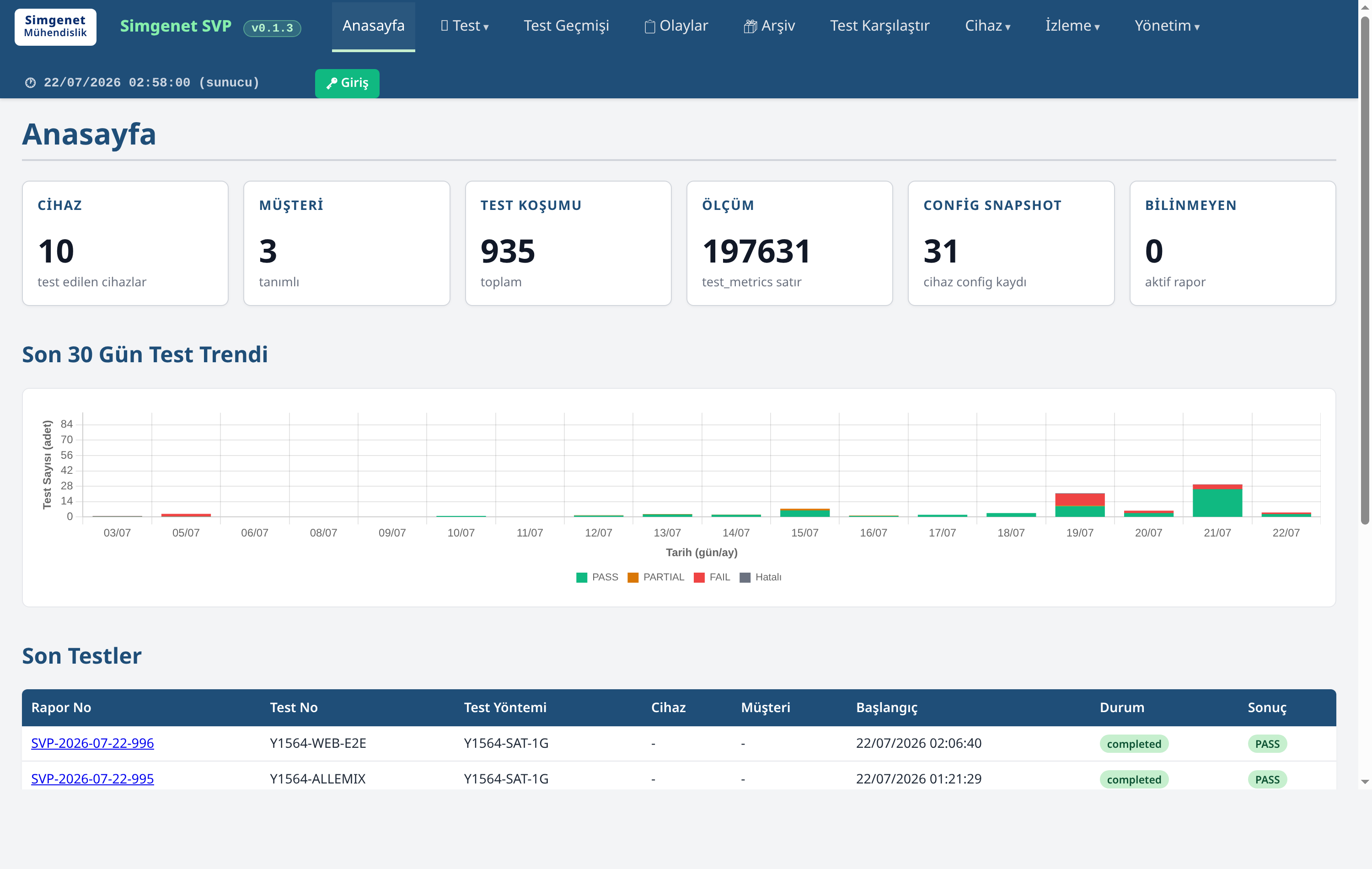
Simgenet SVP Validation Platform
Simgenet SVP (Validation Platform) combines traffic/bandwidth testing (1G–100G), time synchronization (PTP/NTP/gPTP), service OAM, TSN, IEC 61850 and OT-security testing in a single in-house-developed, vendor-independent instrument — documenting every result with evidence-based, lockable reports against international standards.
Simgenet SVP (Validation Platform) is a fully in-house, vendor-independent network test and validation platform for verifying routers, switches, time servers and line quality against RFC / ITU-T / MEF / IEEE / IEC references in critical-infrastructure, service-provider and power-utility (IEC 61850) networks. Any manufacturer's device is tested with two test ports and standard methodology. Every test is stored in the database with its parameters, raw data and PASS/FAIL verdict, and produces a customer-deliverable, lockable report.
Why SVP?
- Single platform: capabilities that require separate instruments or licenses on commercial testers, in one box — Ethernet traffic/bandwidth (1G→100G), PTP/NTP/gPTP timing, Y.1731 OAM, TWAMP/STAMP, TSN, IEC 61850/HSR-PRP and OT-security testing.
- Hardware-timestamped, nanosecond-class measurement: functional validation, conformance and SLA activation in field and lab.
- Transparent evidence philosophy: the report states not only the result but what the test does and does not prove (duration-validity tiers, raw-data appendix, compliance stamp).
Ethernet Performance & Bandwidth (1G–100G)
- RFC 2544: throughput (NDR binary search + sweep), latency, frame loss, back-to-back burst (RFC 9004); 64…9600B jumbo and IMIX/EMIX profiles.
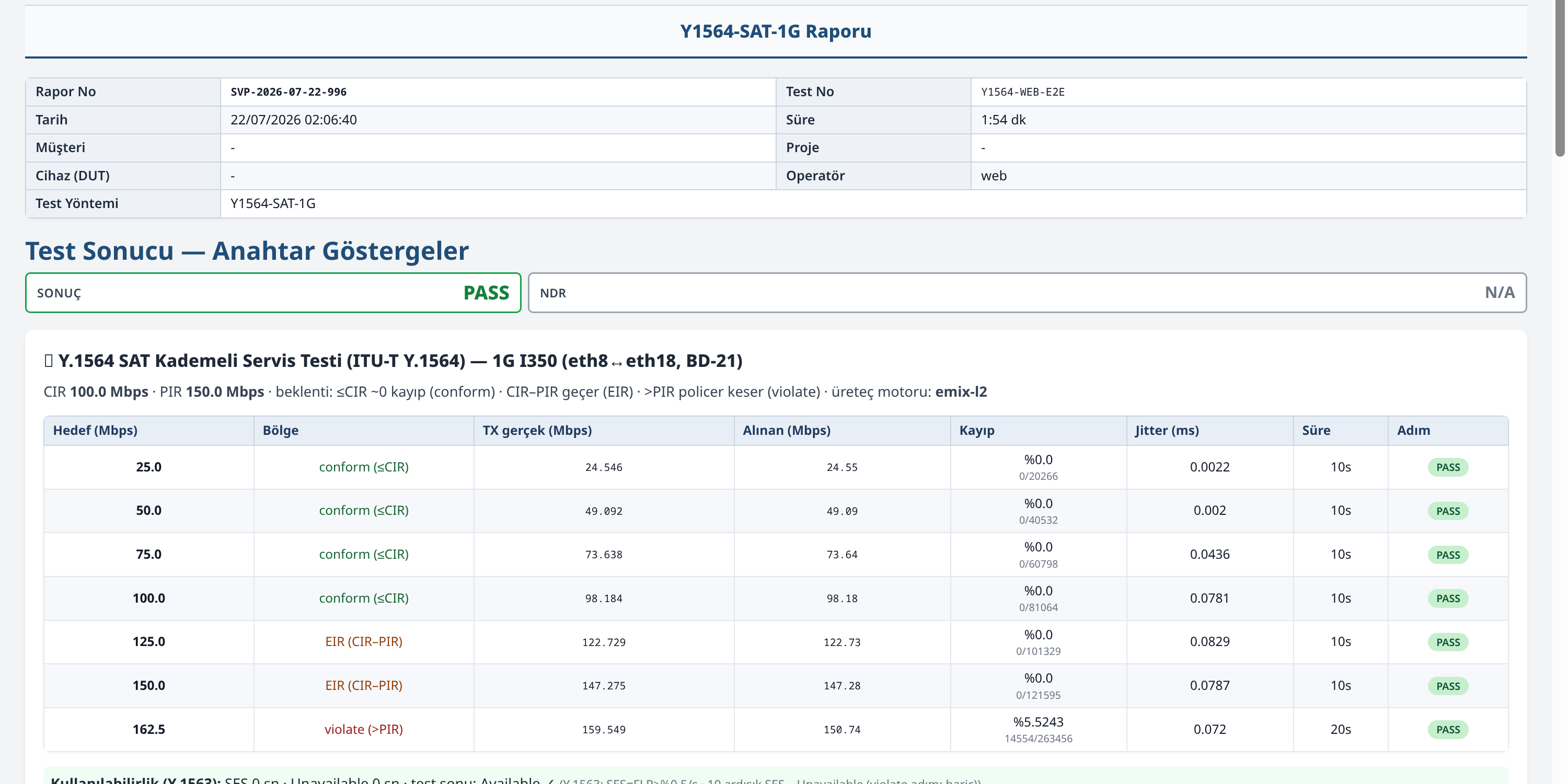
- ITU-T Y.1564 (SAT): CIR/EIR/CBS/EBS, color-aware multi-service, policing, Y.1563 availability.
- RFC 6349 TCP, RFC 2889 L2 switch, RFC 3918 multicast tests.
- In-house EMIX L2 engine: FLR / FTD / FDV / dup / reorder in a single tool; MEF 66 latency histogram; PCAP export; controlled impairment injection; protection-switching / ring failover time (TI-LFA, ERPS, HSR/PRP).
Time Synchronization (PTP / NTP / SyncE)
- Hardware-timestamped measurement: cTE/dTE/maxTE, MTIE/TDEV, PDV suite; PASS/FAIL against standard masks — G.8273.2 (Class A/B/C), G.8272 PRTC, G.8271/G.8271.1, IEC 61850-9-3 / IEEE C37.238, Y.1541.
- PTP under load and under noise, BMCA dual-GM failover, 24h+ holdover, automatic path-asymmetry detection, PTP auto-discovery ("just plug the cable").
- SyncE (G.8262/G.8264) ESMC/QL analysis · NTP offset/RTT/stratum + load test.
TSN (Time-Sensitive Networking)
- 802.1AS/gPTP time-synchronization verification — nanosecond class.
- 802.1Qbv time-aware shaper (gate / bounded-latency / determinism), 802.1Qbu frame preemption and 802.1CB FRER redundancy validation.
IEC 61850 / Power Utility Automation
- GOOSE/SV generation + analysis + capture; SCL import for automatic scenarios; QoS-61850 GOOSE-protection under load.
- Power-Profile PTP (IEC 61850-9-3 / IEEE C37.238); HSR/PRP RedBox seamless failover (IEC 62439-3).
- R-GOOSE / R-SV (IEC 61850-90-5): routable GOOSE/SV over WAN/5G — wide-area protection and virtual-substation scenarios.
OT / Cyber Security (IEC 62351)
- IEC 61850/62351 security-compliance and resilience test module — SVP generates the attack and measures the device's / IDS's response (an active resilience tester, not a passive IDS or a penetration-testing platform).
- GOOSE poisoning/replay/flooding, R-GOOSE replay/spoofing, PTP/GNSS time-spoofing, IEC 62351-6 forged-HMAC rejection tests.
5G / Mobile Transport
- GTP-U (N3/N6) traffic testing (mobile backhaul / private-5G); base-station time-error budget and PRTC metrics.
Reporting & Automation
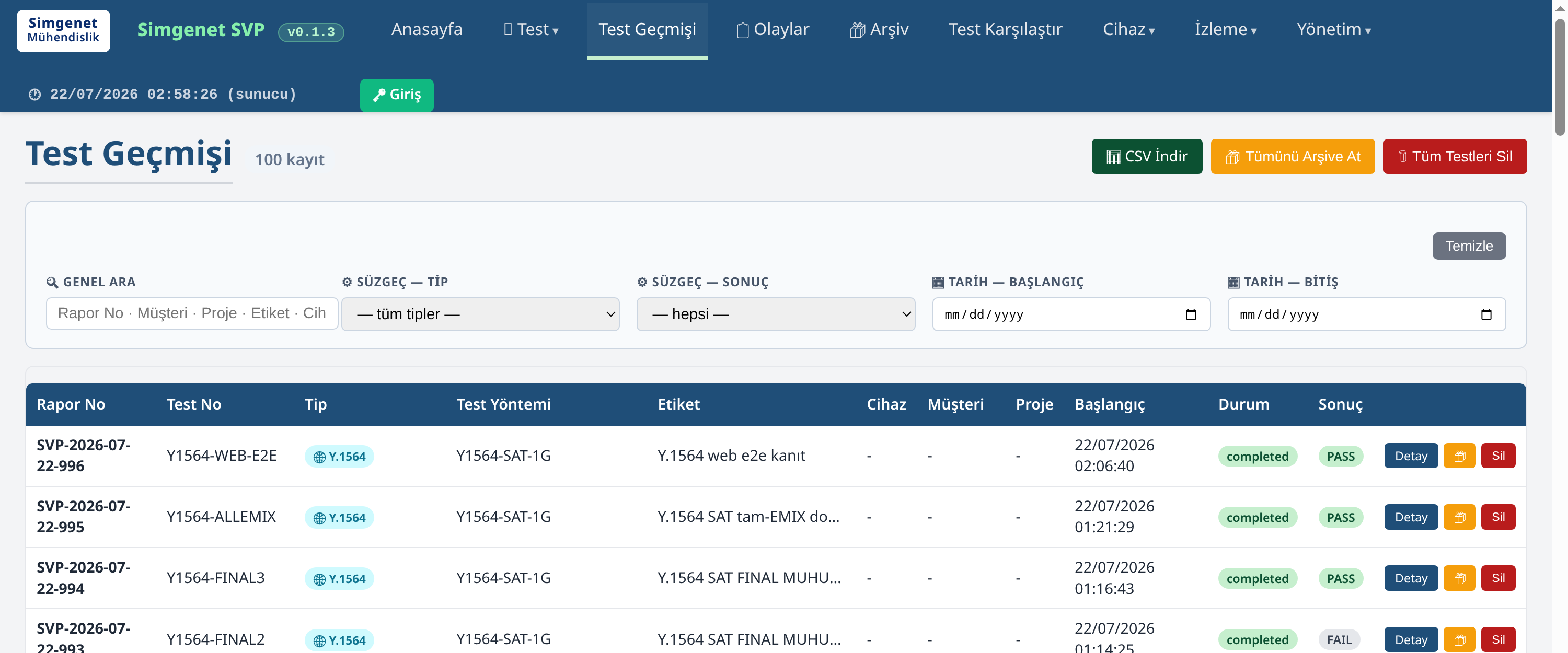
- Report-no + test-no + customer/project/device metadata in PostgreSQL; PDF/CSV/HTML; raw-data appendix; compliance stamp + report lock.
- Auto-Test (unattended multi-test + best-config recommendation), in-DUT bottleneck analysis, on-device correlation on FAIL.
- HTTPS web interface (role-based), REST API (OpenAPI), SNMP (SIMGENET-SVP-MIB) + NMS/Zabbix; Cisco/VyOS/SMGOS/Linux DUT adapters.
Applications
- Telecom / ISP: SLA activation (Y.1564/RFC 2544), OAM, 1G→100G performance, SyncE + PTP telecom profiles.
- Energy / Substation: IEC 61850 GOOSE/SV, power-profile PTP, QoS-61850, R-GOOSE, OT security.
- Railway / Transportation: Ethernet performance + PTP/802.1AS + HSR/PRP redundant-topology validation.
- 5G / Mobile: GTP-U traffic testing, base-station synchronization.
- Industrial Automation / TSN · Metrology/Lab · Data Center.
Hardware (SVP-100G)
- Test ports: 1G · 10G · 100G (QSFP28), modular NIC architecture; NIC hardware timestamping (PHY/PTP); DPDK/TRex + in-house EMIX L2 engine; PostgreSQL storage.
| General | |
| Product | Simgenet SVP — Simgenet Validation Platform (Model: SVP-100G) |
| Positioning | Independent, vendor-agnostic network test and validation platform |
| Ethernet Performance Testing | |
| RFC 2544 | Throughput (NDR), latency (LIFO/FIFO/LILO), frame loss, back-to-back burst (RFC 9004); 64-9600B + IMIX/EMIX |
| ITU-T Y.1564 SAT | CIR/EIR/CBS/EBS, color-aware, multi-service concurrent; policing CIR+1.25×EIR SAC band; Y.1563 availability (SES) |
| RFC 6349 | TCP throughput: BDP/RWND, Transfer-Time-Ratio, Efficiency %, Buffer-Delay % |
| RFC 2889 / RFC 3918 | L2 switch (MFR, HOL, address learning, broadcast) / multicast (join-leave, group capacity) |
| Energy / OT Protocol Tests | IEC 60870-5-104 and DNP3 — master↔outstation over a real network |
| Physical Layer / BER | PRBS-based link diagnostics and error-rate measurement; G.826 ES/SES/BBE/UAS |
| NMS / SNMP Tests | SNMP accuracy (v2c/v3), notification reliability and storm, scale load (virtual device fleet) |
| Calibration and Uncertainty | Loopback calibration event record (as-found / as-left), GUM measurement uncertainty (k=2), guard-band decision rule |
| Report Sealing | Report number and header, report lock, integrity via report hash, witnessed review |
| EMIX L2 engine | In-house generator/receiver: FLR/FTD/FDV + dup/reorder, 802.1Q PCP/DEI, L1 pacing, own seq+timestamps |
| Advanced analysis | MEF 66 latency histogram, micro-burst, latency-under-load, PDV/IPDV (RFC 5481), PCAP export |
| Impairment | Controlled delay/loss/jitter/reorder/dup injection for resilience testing |
| Failover measurement | Protection switching / ring disruption time (ms) and loss window (TI-LFA, ERPS, HSR/PRP) |
| Load generation | 100G DPDK/TRex engine + stress testing |
| Ethernet OAM — ITU-T Y.1731 / SOAM | |
| Measurements | ETH-CC (continuity/LOC), ETH-DM (FD/FDV), ETH-LM (frame loss), ETH-SLM/SLR (MEF 35.1 synthetic loss) |
| Modes | Self-test and real-DUT (peer MEP); in-service measurement |
| TWAMP / STAMP / OWAMP | |
| TWAMP (RFC 5357) | Always-on reflector + stateful sessions; forward/reverse loss separation; TWAMP-Light |
| STAMP (RFC 8762) | Sender + reflector; TWAMP-STAMP reflection auto-detection |
| OWD | True one-way delay via PTP synchronization |
| Time Synchronization — PTP (IEEE 1588) | |
| Metrics | cTE / dTE / maxTE, MTIE / TDEV, PDV suite (FPP/FPC/FPR — G.8261.1) |
| Standard masks | G.8273.2 A/B/C · G.8272 PRTC A/B · G.8271/G.8271.1 · IEC 61850-9-3 / IEEE C37.238 · Y.1541 |
| Advanced tests | PTP under load, noise tolerance, delay_req load, 24h+ holdover, automatic asymmetry detection, v2/v2.1 interop |
| GM analysis | Full announce field set + change-event tracking; PTP auto-discovery (domain/profile/GM) |
| Duration discipline | cTE ≥1000s, field conformance ≥10000s; explicit warning on insufficient duration |
| SyncE / NTP | |
| SyncE | ITU-T G.8262/G.8264 — ESMC/QL analysis, QL transition tracking, SyncE-PTP hybrid |
| NTP | offset/RTT/stratum/root-delay; RMS; NTP under load; server pool management |
| TSN | |
| Profiles | gPTP (802.1AS), 802.1Qbv gate/determinism, 802.1Qbu preemption, 802.1CB FRER |
| IEC 61850 / Power | |
| GOOSE/SV | Generation + analysis + capture (sniff); automatic scenarios via SCL import; QoS-61850 criteria |
| HSR/PRP | RedBox seamless failover measurement (IEC 62439-3); Power-Profile PTP masks |
| Reporting and Records | |
| Records | Report no + test no + customer/project/device/operator; raw data in PostgreSQL (DB-first) |
| Reports | PDF/CSV/HTML/print; raw-data appendix; compliance stamp + report lock; engineer notes |
| Analysis | Test comparison, archive, re-run, diagnostic bundle; event log + audit trail |
| Management and Integration | |
| Interface | HTTPS web (role-based: admin/operator/viewer) + REST API (OpenAPI) — full automation |
| Monitoring | SNMP traps (SIMGENET-SVP-MIB) + NMS/Zabbix integration; periodic conformance rounds; watchdog |
| DUT automation | Cisco/VyOS/SMGOS/Linux adapters; port discovery; wiring map; auto-test sessions |
| Diagnostics | In-DUT bottleneck analysis; glitch classifier; hardware sensor monitoring; on-device correlation |
| Hardware Platform (SVP-100G) | |
| Test ports | 1G · 10G · 100G (QSFP28) — modular NIC architecture |
| Timestamping | NIC hardware timestamp (PHY/PTP), ns-class |
| Engine | DPDK/TRex (100G) + in-house EMIX L2 engine |
| License Packages | |
| Rate class | 1G / 10G / 100G test capacity |
| Packages | Ethernet Performance · OAM (Y.1731/TWAMP/STAMP) · Timing (PTP/NTP/gPTP) · TSN · Power (61850/HSR-PRP) |