Simgenet SMG Unified Storage Server
Simgenet SMG Unified Storage Server
The Simgenet SMG Unified Storage Server is an enterprise storage server with in-house developed software that brings all of your organization's data together in one secure device. From file sharing to backups, from camera and voice recordings to virtual-server disks, it meets all your storage needs in a single solution. Your data is protected with strong encryption and automatic backups, the device repairs itself against disk failures, and it easily expands as your needs grow. Everything is managed from one simple screen; installation, maintenance and technical support are provided from Türkiye with Simgenet assurance.
Simgenet SMG Unified Storage Server
The Simgenet SMG Unified Storage Server is a central storage solution where you can safely keep all of your organization's data. It brings together very different needs — file sharing, backup, camera and voice recordings, virtual-server disks and long-term archiving — in a single device. So instead of buying several devices from different brands, you work with a single solution that is easy to install and manage and that grows as you grow. The device runs on long-life, enterprise-grade server systems designed for 24/7 continuous operation. Its software is developed by Simgenet in Türkiye; installation, maintenance and technical support are provided with Simgenet assurance.
What sets Simgenet apart: it combines object, file and block access in a single panel; a single software runs on all hardware (hardware-agnostic, no vendor lock-in); Simgenet devices recognize each other automatically and communicate encrypted; as the data layer of the Simgenet platform it consolidates IP PBX recordings, router backups and central logs in one place; it integrates fully as a datastore with VMware, Proxmox VE and Hyper-V virtualization systems; and its software is developed in-house, Simgenet-branded and managed from a single user-friendly panel.
Unified Access: Object, File and Block
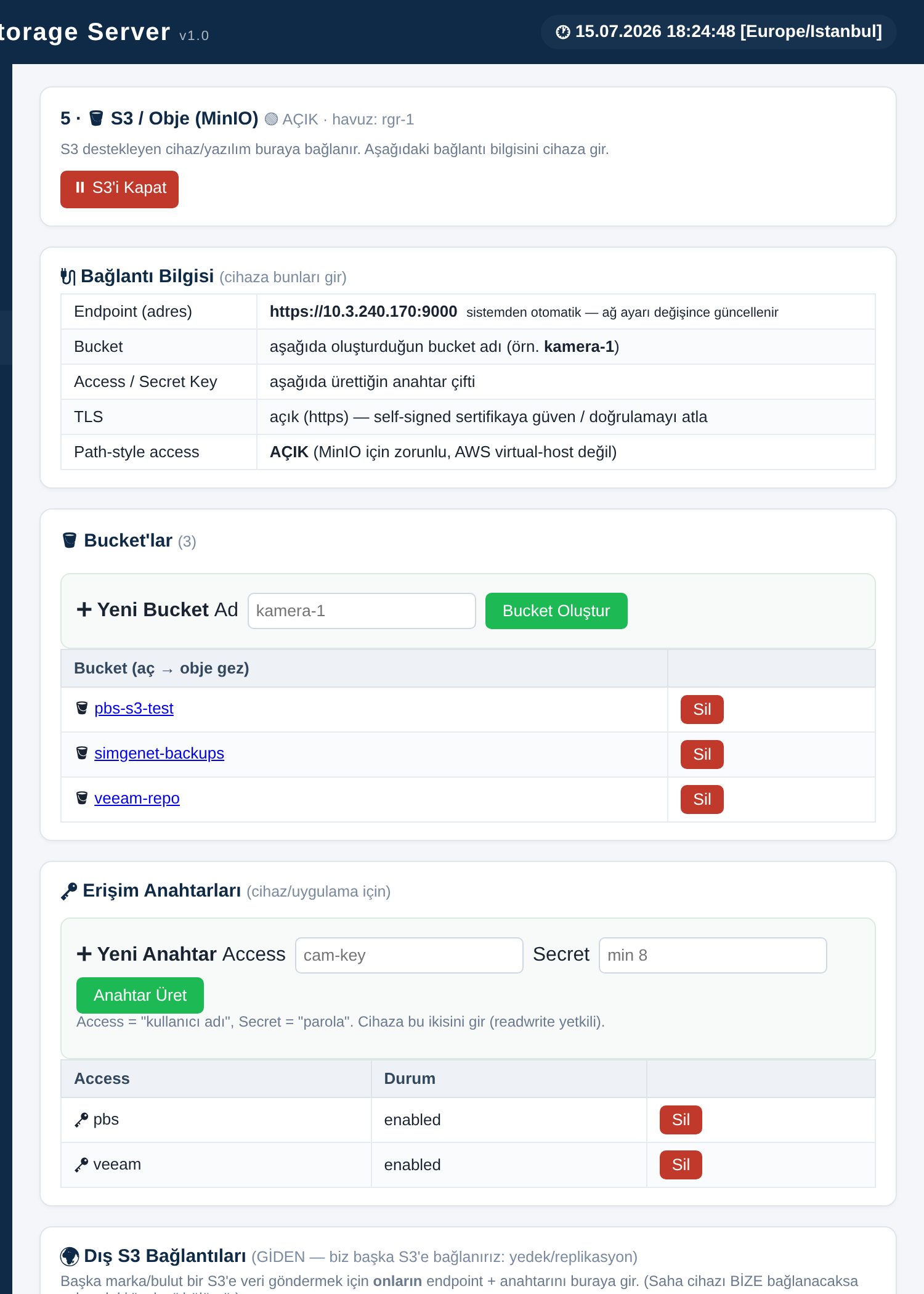
The device provides all access methods expected from a storage server at the same time. The S3-compatible object store (MinIO) works with versioning and object-lock; SMB/CIFS serves Windows shares with Previous Versions support; NFS serves Linux and virtual machines; the iSCSI block target is provided with CHAP authentication; and SFTP supports secure file transfer. An NVMe over TCP (NVMe-oF/TCP) block target is offered to allowed clients only. While file sharing or S3 can be used freely on the local network, S3 is recommended over the wide-area network (WAN), because multipart upload, resume and TLS use bandwidth in the most efficient and secure way.
Data Protection and Security
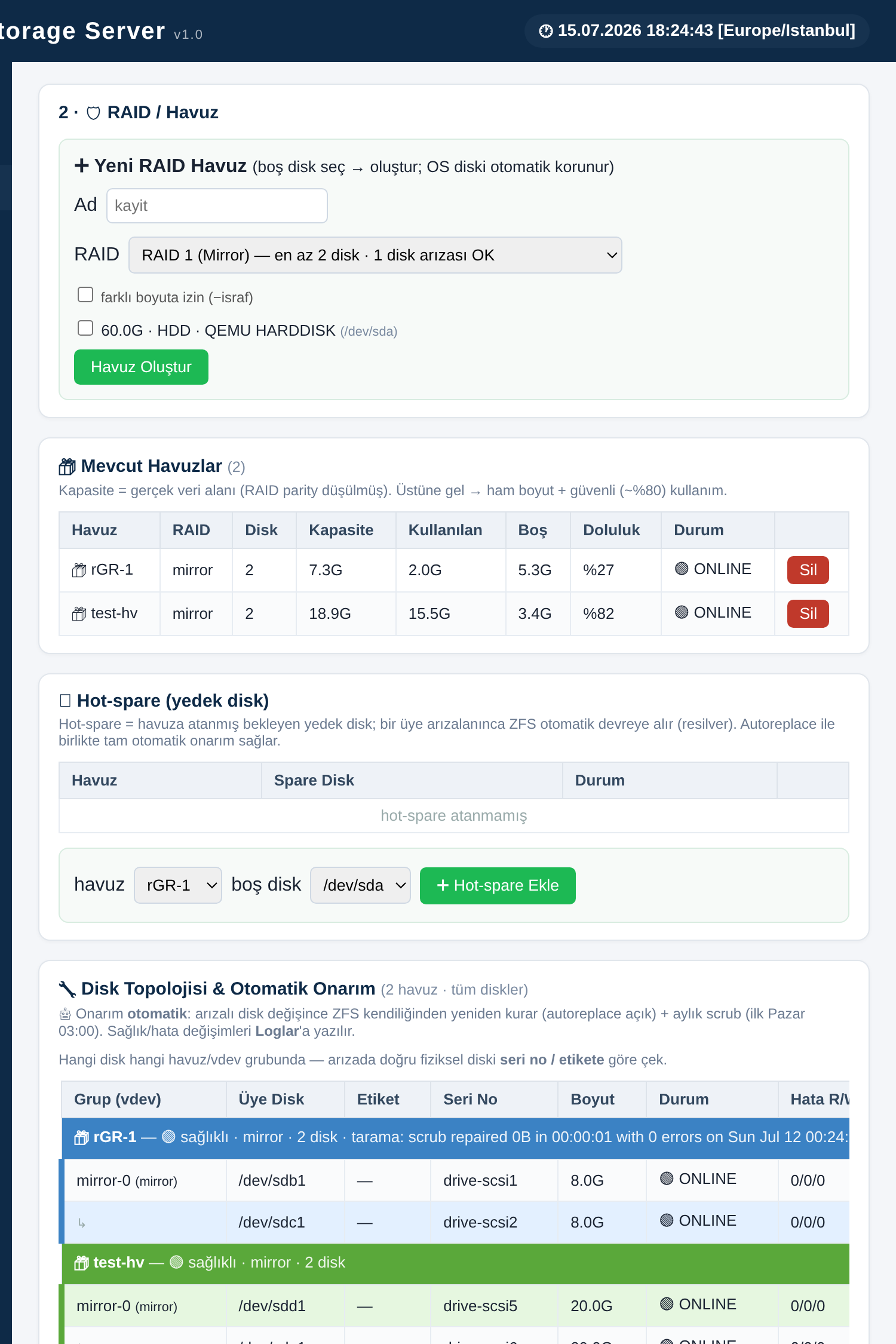
Data integrity is protected by ZFS's Copy-on-Write architecture and automatic repair (autoreplace + regular scrub). The device supports mirror, RAID-Z1/Z2/Z3, stripe and nested RAID 10/50/60 levels, instant and scheduled snapshots, object versioning and immutable WORM/object-lock archiving. On the security side, data is encrypted at rest with AES-256 with the key protected by TPM2, and in transit with TLS 1.3; when ransomware behavior is detected, an alarm is raised and a protective snapshot is taken; access is managed with role-based access control (RBAC), destructive operations require two-step approval, and enterprise authentication is centrally handled through RADIUS, LDAP and TACACS+.
Management and Ease of Use
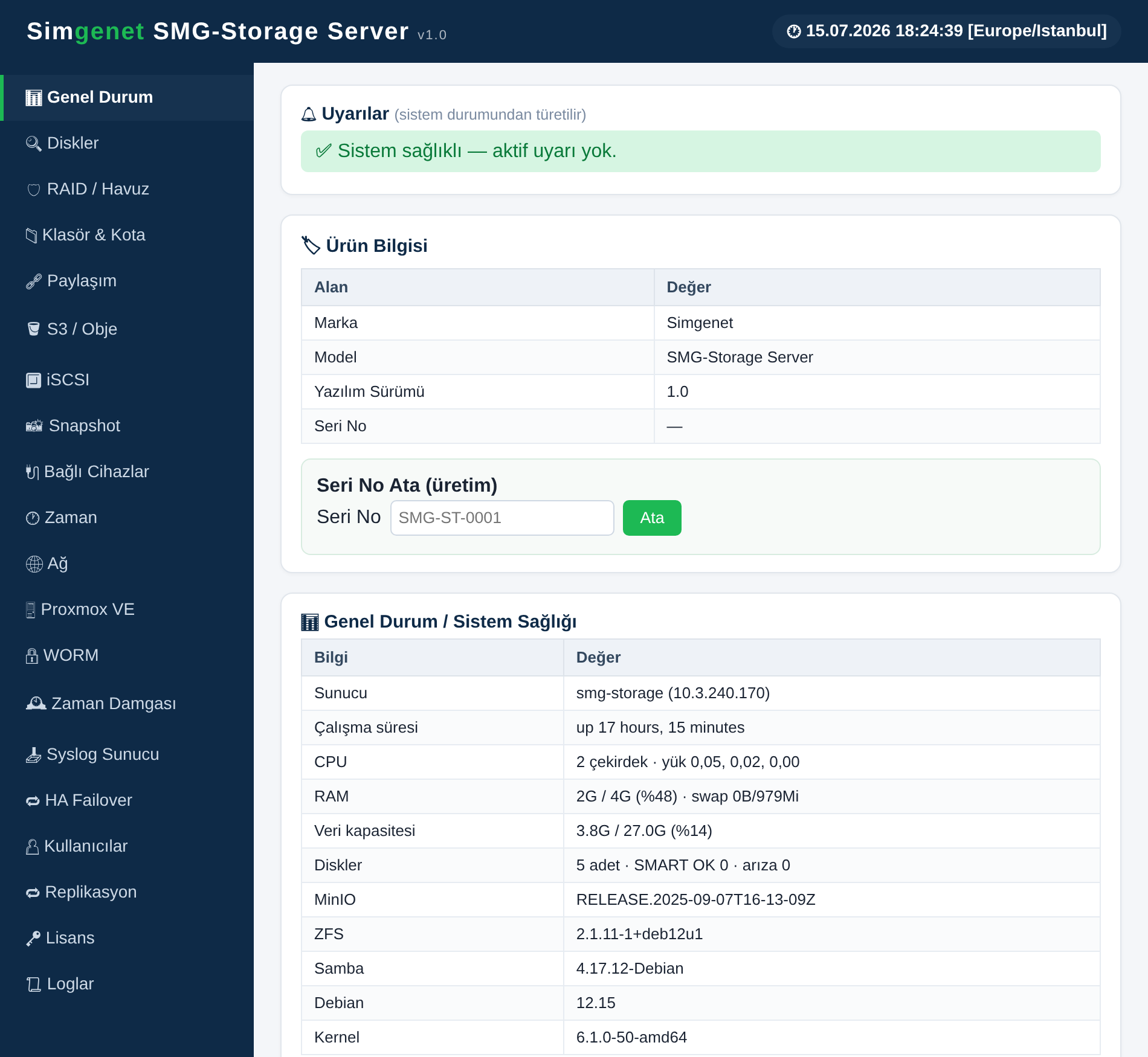
The management interface is comprehensive yet simple and user-friendly. Thanks to its Excel-like matrix table structure, disk, RAID, folder, quota, share, S3, iSCSI, snapshot, user and replication operations are configured easily from a single panel. Success or error information is shown instantly after every operation, the interface refreshes live every 30 seconds without a page reload, and serial-number-based disk labeling makes it easy to find the correct physical disk during a failure. Multiple Ethernet interfaces are auto-detected; bond/LACP, VLAN and jumbo frames are supported. All functions can also be automated through the REST API.
Monitoring, Alarms and Audit
The device continuously monitors disk, pool, capacity, temperature and service status and raises alarms following the ITU-T X.733 model when a problem occurs. Each alarm explains in plain language what happened, why it matters, the probable cause and what to do; once the problem is resolved, the alarm clears automatically. Users are authorized with administrator, operator and viewer roles, and every action is written with its result to a hash-chained, tamper-evident audit log. The device clock is fed from GNSS and NTP sources, and source changes are recorded as well.
High Availability and Platform Integration
The device provides high availability with a dual-controller design, encrypted ZFS replication between two boxes, RPO=0 metro synchronous writes and S3 site replication; Simgenet devices recognize each other automatically and connect encrypted. It also serves as the data layer of the Simgenet platform: IP PBX call recordings, SMGOS router configuration and firmware backups, central syslog and telemetry are consolidated on this storage. The built-in syslog server stores logs with RFC3161 timestamping and a signed, tamper-evident archive.
| Engine / Foundation | |
| Operating System | Simgenet appliance (Debian Linux based) |
| Object / S3 Engine | MinIO — S3-compatible object storage (TLS) |
| Disk / Pool Engine | ZFS (Copy-on-Write) + hardware RAID support |
| Architecture | Modular · single software, hardware-agnostic |
| Access Protocols (Block · File · Object) | |
| S3 (Object) | MinIO — buckets, versioning, object-lock · inbound (server) + outbound (client: replicate to external S3) |
| SMB / CIFS | SMB3 (Samba) · Windows shares · Previous Versions (shadow copy) |
| NFS | v3 / v4 — Linux and virtual machines |
| iSCSI | Block target · CHAP authentication |
| NVMe-oF / TCP | NVMe over TCP block target · allowed-client (host NQN) list · automatic activation at boot |
| SFTP | Secure file transfer · embedded file + S3 object browser in the panel |
| Access Guidance | LAN → file/S3; WAN → S3 (multipart + resume + TLS, uses bandwidth efficiently) |
| Client Authentication | Active Directory / LDAP / Kerberos · POSIX ACL |
| RAID / Pool Management | |
| RAID Levels | mirror (R1), raidz1 (R5), raidz2 (R6), raidz3, stripe (R0), dRAID · RAIDZ expansion (grow by adding disks) |
| Cache Tiers | L2ARC read cache · SLOG write log · special vdev (metadata) |
| Nested | raid10, raid50, raid60 · hot-spare (automatic) |
| Disk-Size Tolerance | Diff ≤10% free · 10–50% with approval · >50% rejected (prevents nonsensical RAID) |
| Auto-Repair | ZFS autoreplace (on by default) + monthly scrub · disk topology (vdev/STATE/R-W-C) |
| Protection | OS disk cannot be added to RAID (protected) · capacity coercion · real capacity (parity-adjusted) |
| Disk Management | |
| Health | SMART / temperature / disk tests / bad-block · health changes written to audit log |
| Disk Labeling | Slot/rack/row label bound to serial number (persists across dev-name/pool changes) — find the right disk on failure |
| Disk Info | Type (SSD/HDD/NVMe + M.2/2.5"/3.5") · vendor/model · hot-swap detection · async hot-plug scan |
| Operations | Format / Mount / Wipe / Secure Erase / Replace · hardware-agnostic (SATA/SAS/SSD/NVMe) |
| Capacity / Quota / Reserve | |
| Quota | Folder quotas (unlimited count) · total quota cannot exceed usable capacity (guard) |
| Reserve | Adjustable 0–30% (default 10% + 8 GiB floor) — free space for ZFS CoW performance/health |
| Data Protection | |
| Snapshot | Instant + scheduled policies (hourly / daily / weekly / monthly, retention count per class) · browse snapshot contents |
| Versioning / WORM | MinIO object versioning + WORM / Object-Lock — immutable archive (compliance) |
| Compression | Inline LZ4 / ZSTD |
| Deduplication | ZFS block-level · enabled per dataset |
| Clone / Hold | ZFS instant clone (writable snapshot) · snapshot hold to protect against deletion |
| Erasure Coding | MinIO erasure coding (large scale) |
| Recycle | Recycle bin + version rollback |
| High Availability / Replication | |
| HA Model | Dual controller (shared JBOD, SCSI-3 PR fencing) · two-box HA (scheduled encrypted ZFS replication, virtual IP, witness node) |
| Metro Sync | RPO=0 synchronous writes (DRBD 9, protocol C) · two data nodes + witness |
| Object Replication | S3 site replication (active-active) + failover |
| Auto Connect | Simgenet-to-Simgenet auto-recognition + encrypted link (zero config) |
| Interoperability | Compatible with any vendor via standard protocols (S3/NFS/SMB/iSCSI) |
| Security | |
| Encryption (Disk) | AES-256 data-disk encryption · key sealed with TPM2, recovery key held centrally · per-tenant keys · KMIP client |
| Encryption (Transit) | TLS 1.3 (AES-256) |
| Management Security | HTTPS enforced · RBAC · two-step approval on destructive actions · audit logging · rate-limit · login attempt lockout (IEC 62443-4-2 CR 1.11) |
| Ransomware Detection | Multi-signal detection (mass rename/delete, encrypted file writes, canary files) · alarm + protective snapshot |
| User Roles | Administrator · Operator · Viewer — permissions per role; viewers can only view and cannot export |
| Audit Log | Hash-chained, tamper-evident log · every action recorded with its result (success / failure / denied) · all downloads logged · advanced filtering + CSV |
| Device Certificate | Automatic certificate enrollment and renewal from the organization's PKI via EST (RFC 7030) · same identity for web (HTTPS) and syslog-TLS · revocation checking via OCSP |
| Central Identity (AAA) | RADIUS / LDAP / TACACS+ · role mapping |
| Web Management (single panel) | |
| Management Experience | Comprehensive yet simple — Excel-style matrix tables (disk × feature, folder × protocol, tenant × service); complex tasks made user-friendly on one screen |
| Panel Sections | Overview · Alarms · Disks · RAID/Pool · Folder&Quota · Shares · S3 · iSCSI / NVMe · Snapshot · Connected Devices · Network · WORM · Timestamping · Syslog · HA/Failover · Users · Replication · License · Logs |
| Connected Devices | Active SMB/NFS/iSCSI/S3 sessions · Simgenet brand/model badge (auto-recognition) · inbound/outbound · live |
| Network | Multi-NIC auto-detect · per-interface IP/subnet · live IP validation · single gateway |
| Usability | 30 s live refresh (no F5) · success/error banner on every action · matrix-table configuration |
| Alarms | ITU-T X.733 alarm model · pool / SMART / capacity / temperature / service alarms · a plain-language explanation for every alarm (what happened, why it matters, probable cause, what to do) · automatic clearing · acknowledgement · history, filtering and CSV |
| Integration and Logging | |
| API and Notifications | REST API (OpenAPI, token) · CLI · SNMP · syslog / e-mail / webhook notifications |
| Syslog Server | Central log receiver (rsyslog 514 / 6514-TLS) + RFC3161 timestamping + signed, tamper-evident archive |
| Backup Compatibility | Veeam · Proxmox Backup Server (PBS) · rsync · S3/iSCSI target |
| Legal Log Retention | Law 5651 compliant · RFC 3161 timestamped, signed daily archive · configurable minimum retention period |
| Virtualization Integration | |
| VMware ESXi | iSCSI / NFS datastore |
| Proxmox VE | ZFS-over-iSCSI + direct iSCSI (CHAP) · dedicated Proxmox VE panel tab |
| Microsoft Hyper-V | SMB3 / iSCSI |
| Shared Storage | VM datastore · live-migration compatible shared storage |
| Platform Integration | PBX call recordings (S3) · SMGOS config/firmware backup · log/SOE · telemetry |
| Time Source | Multiple GNSS / NTP sources · automatic or manual source selection · source changes and loss of synchronization are written to the event log |
| Time | 598 time zones · region-based live top-bar clock |
| Installation and Licensing | |
| Installation | ISO / automated installer |
| Updates and Configuration | Signed update package · configuration backup / restore · reset to defaults |
| License | Feature-based software licensing |
| Hardware | |
| Form Factor | Enterprise-grade industrial rackmount server platform (2U / 4U) — long-life server systems designed for 24/7 continuous operation · redundant power, hot-swap drive bays |
| Processor (CPU) | Server-class processor — Simgenet recommends the optimal configuration per requirement |
| Memory (RAM) | DDR5 ECC |
| System Disk | Protected OS disk (cannot be added to RAID/pool) |
| Data Disks | Hot-swap bays · SATA/SAS HDD, SSD, NVMe (hardware-agnostic) |
| Disk Interfaces | SATA (6 Gb/s) · SAS (12 Gb/s) · NVMe (PCIe Gen4 / Gen5) |
| Disk Form Factors | 3.5" / 2.5" / M.2 / U.2 |
| Storage Tiering | Hybrid tiering (NVMe cache + SSD/HDD capacity) · JBOD/backplane expansion |
| High-Speed Access | NVMe-oF (TCP · RDMA — RoCEv2 / iWARP) · iSER · SMB Direct · NFS-over-RDMA · 100G |
| RAID Hardware | ZFS soft-RAID + hardware RAID (HBA/controller) support |
| Network | Multiple Ethernet auto-detect · per-interface IP/subnet · bond / LACP (802.3ad) · VLAN · jumbo frames (MTU 9000) · management and data network separation |
| Power Supply | Redundant power supply |
| Environmental | |
| Operating Temperature | -20°C ~ +60°C |
| Storage Temperature | -40°C ~ +70°C |
| Relative Humidity | 10% ~ 95% (non-condensing) |
| EMC and Compliance | |
| EMC Emission | TS EN 55032:2015+A11:2020 (Class A) |
| EMC Immunity | TS EN 55035:2017+A11:2020 |
| ESD (IEC 61000-4-2) | Level 3 |
| Radiated RF (IEC 61000-4-3) | Level 3 |
| EFT/Burst (IEC 61000-4-4) | Level 3 |
| Surge (IEC 61000-4-5) | Level 3 |
| Conducted RF (IEC 61000-4-6) | Level 3 |
| Magnetic Field (IEC 61000-4-8) | Level 3 |
| Voltage Dips (IEC 61000-4-11) | Level 3 |
| Harmonics | TS EN IEC 61000-3-2:2019+A1:2021 |
| Flicker | TS EN 61000-3-3:2013+A2:2021 |
| Safety (LVD) | TS EN 62368-1:2020+A11:2020 |
| RoHS | TS EN IEC 63000:2018 |
| EU Directives | 2014/30/EU (EMC), 2014/35/EU (LVD), 2011/65/EU+2015/863/EU (RoHS) |
| Target Segment and Use Cases | |
| Target Segment | Enterprise data center · critical infrastructure · backup/archive · recording |
| Use Cases | PBX call-recording archive · SMGOS config/firmware backup · central log/SOE · camera/NVR storage · immutable compliance archive · backup target (Veeam/PBS/S3) |