
Simgenet GNSS Server
Simgenet GNSS Server
The Simgenet GNSS Server is an in-house developed time server that keeps the clocks of every device on your network in step with highly precise time received from satellites. In organizations where accurate time is critical — energy, telecom, finance and broadcasting — it lets all systems share the same moment down to a billionth of a second. This keeps records, transactions and protection systems reliable and consistent with one another. It complies with international standards and is easy to install and manage; installation, maintenance and support are provided from Türkiye with Simgenet assurance.
Simgenet GNSS Server
The Simgenet GNSS Server is a device that provides your entire network with a single accurate and reliable source of time. It takes highly precise time from satellites (GNSS) and distributes it to the servers, network devices and recording systems on your network, so that every device sees the same moment. It is designed for all organizations where accurate time is critical — from power transmission and distribution to telecom networks, finance and broadcasting. It offers the widely used PTP and NTP time protocols on a single platform and distributes reliable, nanosecond-level time across the network.
GM and BC Modes: One Software, Two Roles
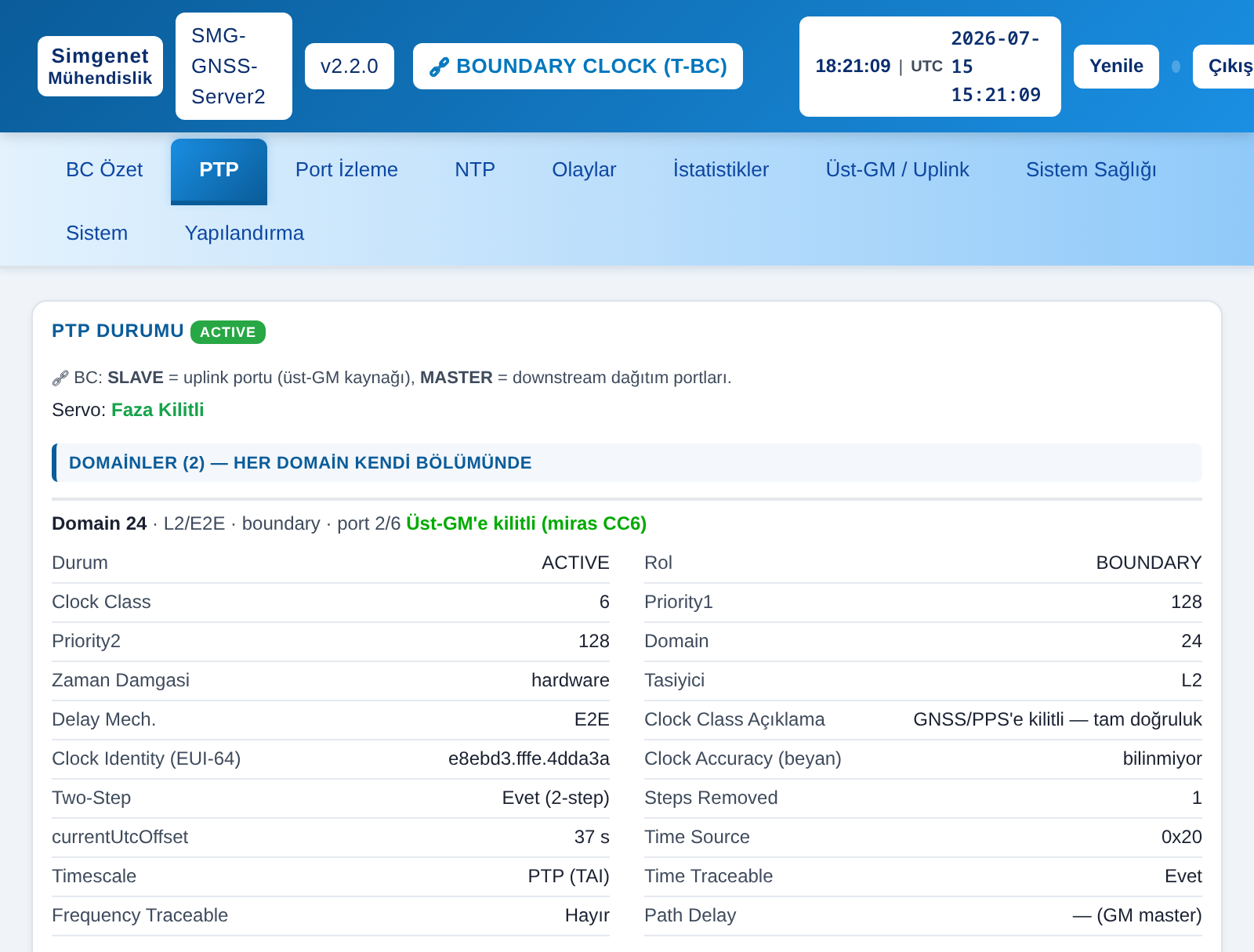
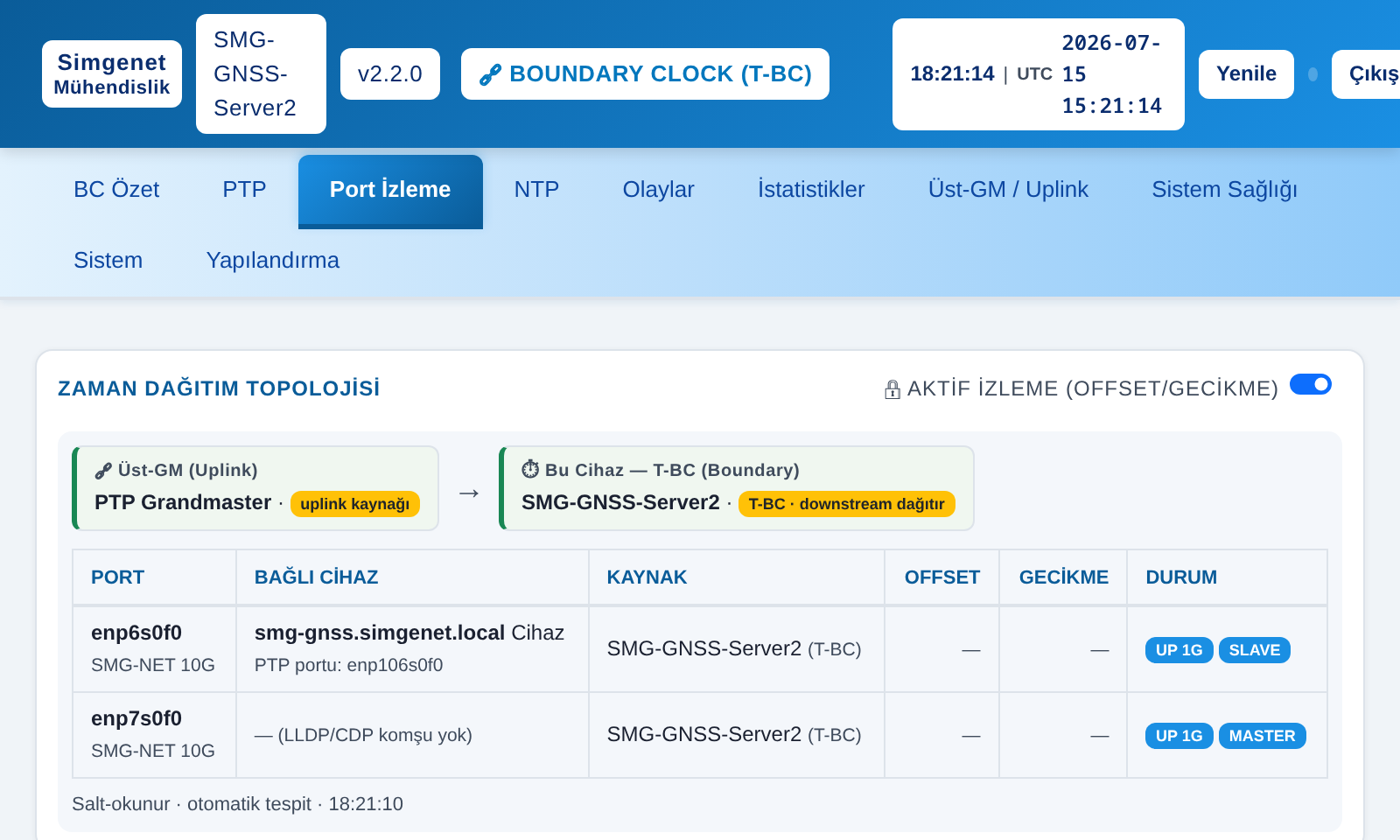
The same device and the same software can operate in two different roles. In Grandmaster (T-GM) mode, the device disciplines the time it receives from the GNSS receiver, becomes the primary time source of the network and distributes time downstream; in this mode the device sits at the top of the timing hierarchy and operates in the ITU-T G.8272 PRTC-A primary reference time clock class. In Boundary Clock (T-BC) mode, the device receives time from an upstream grandmaster over a PTP uplink port, regenerates it and distributes it to downstream devices, thereby extending the timing chain across the network while recovering accuracy at each hop.
The role is selected through the device's per-port configuration matrix: assigning a port as an uplink in a domain automatically switches that domain to Boundary Clock mode and locks it to the upstream grandmaster, while with no uplink selected the device operates as a GNSS-locked grandmaster in that domain. These transitions happen without rebooting the device, and different domains can run on different ports simultaneously (multi-domain). Each Ethernet port on the device can be assigned to a separate domain, profile and role (master or slave).
Timing Accuracy and Standards
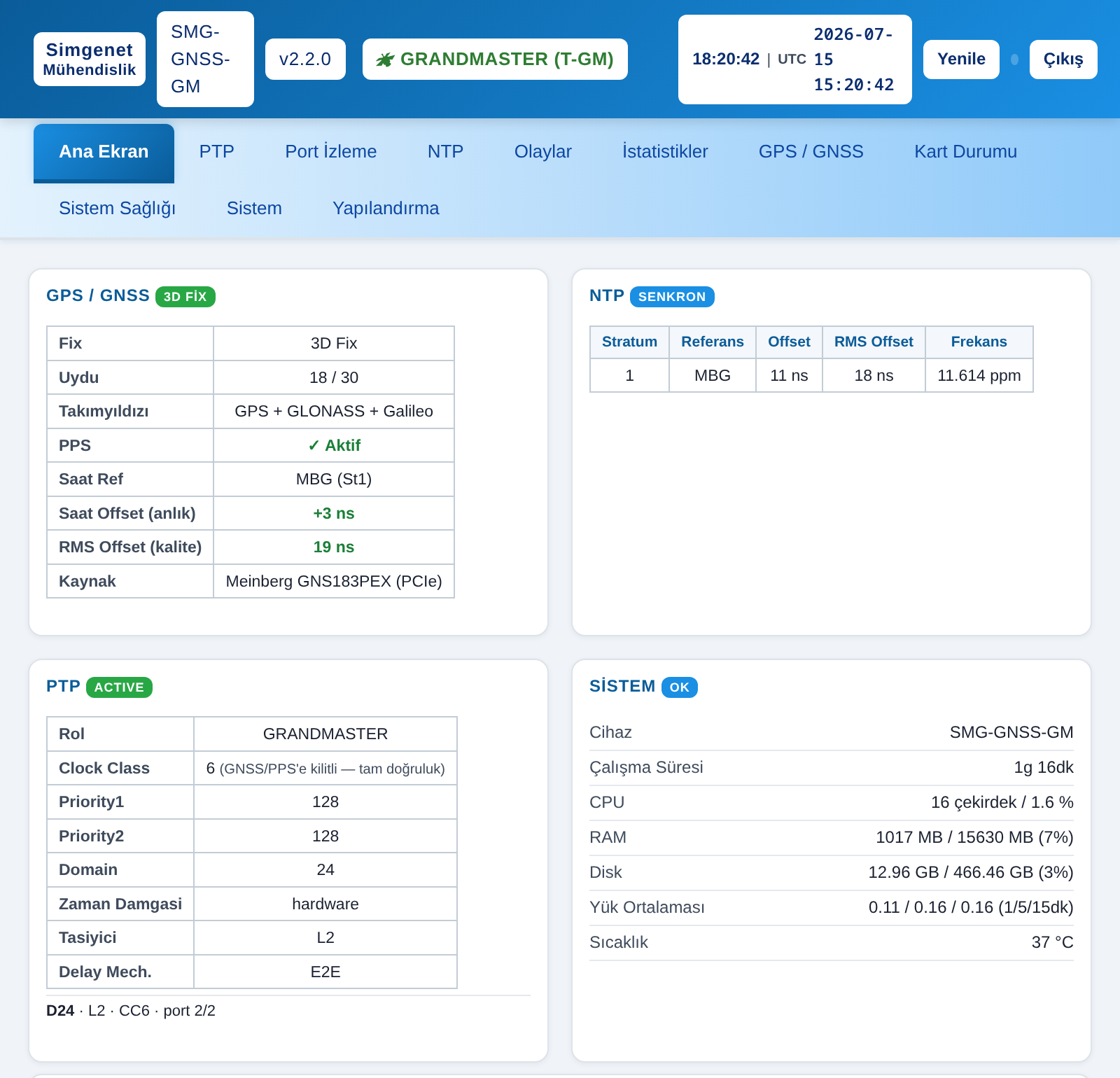
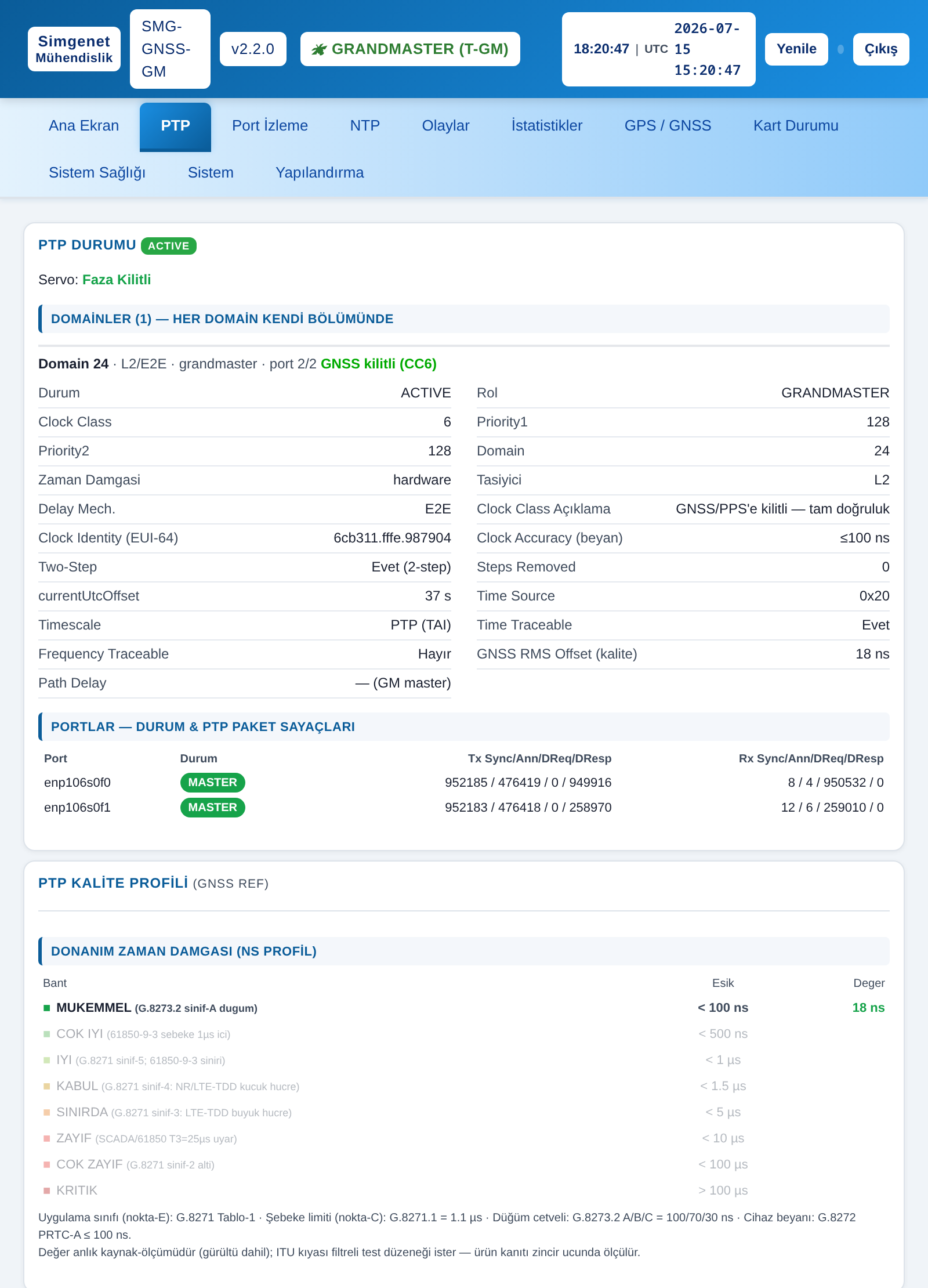
The device uses hardware-level timestamping on its data ports and operates at ITU-T G.8273.2 Class-A node accuracy. In grandmaster mode it produces time in the G.8272 PRTC-A class (≤100 ns); the field-measured GNSS RMS is approximately 19–21 nanoseconds and the filtered maximum time error (maxTE) is approximately 38 nanoseconds. When the GNSS signal is lost, the device continues to hold time within a defined budget thanks to its high-stability holdover oscillator.
PTP Profiles, NTP and Monitoring
The device distributes IEEE 1588v2 PTP over the telecom profiles ITU-T G.8275.1 (Layer 2, end-to-end, domains 24–43) and G.8275.2 (Layer 3/UDP-IPv4, domains 44–63), as well as the power-utility profile IEC/IEEE 61850-9-3 (peer-to-peer). It also operates as a GNSS-disciplined Stratum-1 NTP server. All connected PTP clients are monitored via in-band IEEE 1588 management without requiring a separate management network; PRTC metrics (constant time error cTE, filtered maximum time error maxTE, dynamic time error dTE) are continuously tracked and all events are recorded in a black box.
Management and Security
The management interface is comprehensive yet simple and user-friendly. The entire time infrastructure is managed from a single panel through the BC Overview, PTP, Port Monitor, NTP, Events, Statistics, Upstream-GM/Uplink, System Health and Configuration sections; port-to-domain mappings are configured easily on an Excel-like matrix table. On the security side, the device provides HTTPS-enforced management, role-based access, central authentication (RADIUS, LDAP, TACACS+).
| Operating Modes | |
| Clock Modes | T-GM (Grandmaster, GNSS-fed) · T-BC (Boundary Clock) · Ordinary Clock |
| Mode Switching | Dynamic — auto BC when an uplink is selected, GM when removed (reboot-free, BMCA) |
| PTP (IEEE 1588-2008 v2) | |
| Profiles | ITU-T G.8275.1 (L2, E2E, domain 24–43) · G.8275.2 (L3/UDP-IPv4, E2E, 44–63) · IEC/IEEE 61850-9-3 power (P2P, 0–127) |
| Multi-Domain | Per-port domain/profile — layer and delay mechanism auto-locked |
| Delay Mechanism | End-to-End (E2E) and Peer-to-Peer (P2P) · 2-step |
| Grandmaster / Accuracy | |
| Grandmaster Class | ITU-T G.8272 PRTC-A (≤100 ns) · clockClass 6 · GNSS/PPS locked |
| Timestamping | Hardware (HW) timestamping · ITU-T G.8273.2 Class-A node |
| Measured Accuracy | GNSS RMS ~19–21 ns · maxTE 38 ns · cTE 10 ns (ns-class) |
| Timescale | PTP/TAI (recommended) or ARB/UTC · automatic currentUtcOffset |
| NTP | |
| Server | Stratum-1, GNSS-disciplined · client and server |
| Accuracy | System offset ~7 ns · RMS ~19 ns |
| GNSS / Source | |
| GNSS Receiver | Multi-constellation (GPS / GLONASS / Galileo / BeiDou) + PPS |
| Upstream Source | Upstream-GM uplink (locks to upstream time source in BC mode) |
| Monitoring and Management | |
| Management Experience | Comprehensive yet simple — Excel-style matrix tables (port × domain, client × status); complex timing configuration made user-friendly on one panel |
| Web Panel | BC Overview · PTP · Port Monitor · NTP · Events · Statistics · Upstream-GM/Uplink · System Health · Configuration |
| Client Monitoring | PTP clients monitored via in-band IEEE 1588 management (no management network required) |
| PRTC Metrics | cTE / maxTE / dTE (G.8272 mask) · G.8271/G.8271.1 network limits |
| Logging | Event/alarm log · statistics · port + packet counters · black box |
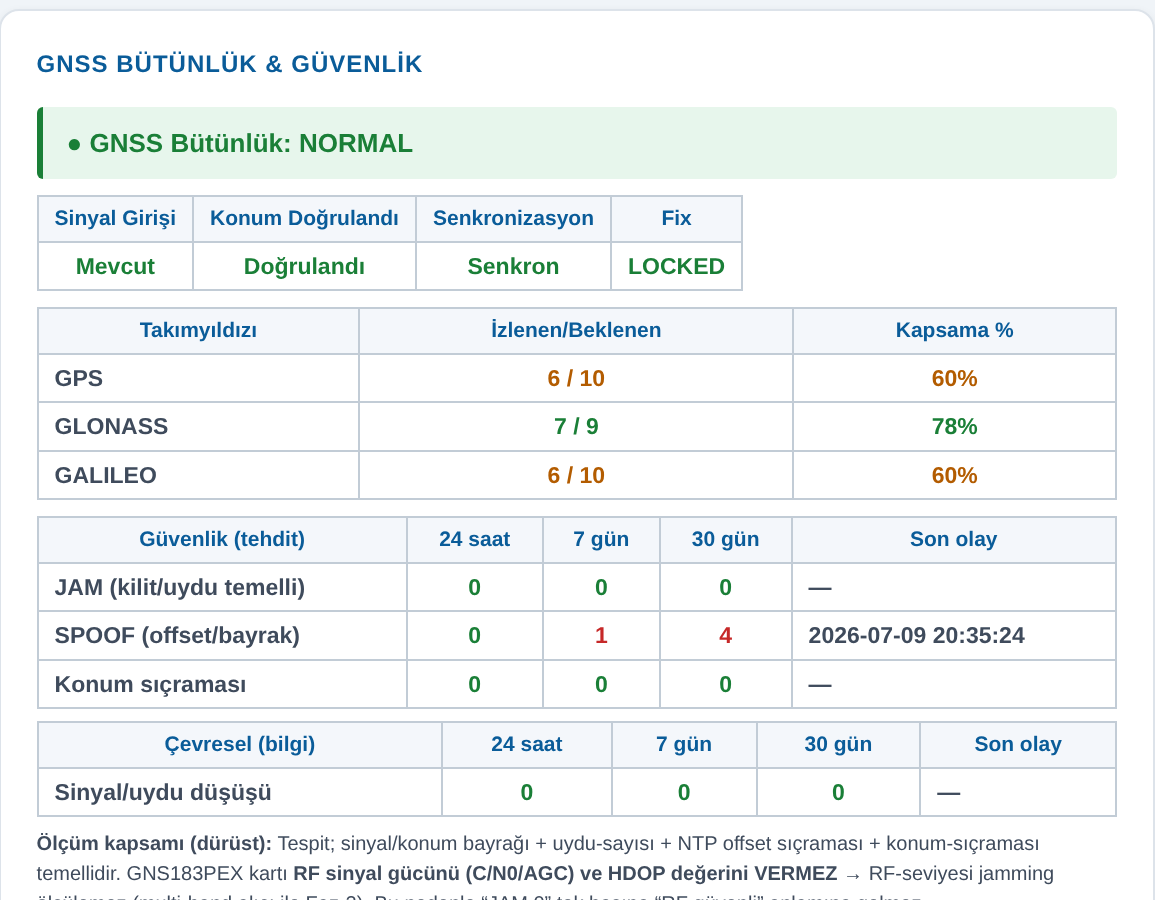
| Never Distributes Wrong Time | Distribution ports stay closed until time is verified; if the source is doubtful the clock class is honestly lowered. Bad time never reaches your network. |
| Survives Antenna Loss | The holdover oscillator keeps time running; when the antenna returns the device re-locks automatically and the accumulated offset is measured and reported. |
| Proves What Happened | At the moment of an outage, drift or clock-class change, a full system snapshot is written to the black box — it ends the "what happened" argument. |
| Field-Stable | Fiber/cable losses are captured instantly; latency-spike hardening is enabled by factory default. |
| Source Management | Source selection by ITU-T G.781 priority, with hysteresis and glitch-free switching. |
| Never Distributes Wrong Time | Distribution ports stay closed until time is verified; if the source is doubtful the clock class is honestly lowered. Bad time never reaches your network. |
| Survives Antenna Loss | The holdover oscillator keeps time running; when the antenna returns the device re-locks automatically and the accumulated offset is measured and reported. |
| Proves What Happened | At the moment of an outage, drift or clock-class change, a full system snapshot is written to the black box — it ends the "what happened" argument. |
| Field-Stable | Fiber/cable losses are captured instantly; latency-spike hardening is enabled by factory default. |
| Source Management | Source selection by ITU-T G.781 priority, with hysteresis and glitch-free switching. |
| Security | |
| Access | HTTPS enforced · RBAC · central identity (RADIUS/LDAP/TACACS+) |
| Branding | Fully Simgenet-branded web interface |
| Installation and Licensing | |
| Installation | ISO / automated installer |
| License | Feature-based software licensing |
| Hardware | |
| Form Factor | Rackmount industrial server |
| GNSS Receiver | Multi-constellation (GPS / GLONASS / Galileo / BeiDou) |
| Antenna | Active GNSS antenna input (surge protection optional) |
| Time/Frequency Outputs | 1 PPS · 10 MHz · ToD (optional) · hardware-timestamped Ethernet |
| Holdover Oscillator | High-stability oscillator during GNSS loss (OCXO; optional Rubidium) |
| Timestamping NIC | Hardware (HW) timestamping, IEEE 1588v2 capable NIC |
| Power Supply | Redundant power supply |
| Environmental | |
| Operating Temperature | -20°C ~ +60°C |
| Storage Temperature | -40°C ~ +70°C |
| Relative Humidity | 10% ~ 95% (non-condensing) |
| EMC and Compliance | |
| EMC Emission | TS EN 55032:2015+A11:2020 (Class A) |
| EMC Immunity | TS EN 55035:2017+A11:2020 |
| ESD (IEC 61000-4-2) | Level 3 |
| Radiated RF (IEC 61000-4-3) | Level 3 |
| EFT/Burst (IEC 61000-4-4) | Level 3 |
| Surge (IEC 61000-4-5) | Level 3 |
| Conducted RF (IEC 61000-4-6) | Level 3 |
| Magnetic Field (IEC 61000-4-8) | Level 3 |
| Voltage Dips (IEC 61000-4-11) | Level 3 |
| Harmonics | TS EN IEC 61000-3-2:2019+A1:2021 |
| Flicker | TS EN 61000-3-3:2013+A2:2021 |
| Safety (LVD) | TS EN 62368-1:2020+A11:2020 |
| RoHS | TS EN IEC 63000:2018 |
| EU Directives | 2014/30/EU (EMC), 2014/35/EU (LVD), 2011/65/EU+2015/863/EU (RoHS) |
| Target Segment and Use Cases | |
| Target Segment | Energy (IEC 61850 substations) · telecom/mobile network · finance · broadcast · defense |
| Use Cases | Network time synchronization (PRTC) · SCADA/SOE time-stamping · 5G/LTE-TDD phase sync · data-center time distribution |